The idiom “you can’t have your cake and eat it too” means that a person cannot simultaneously possess an item and consume it. Metaphorically speaking, it means that a person cannot enjoy the benefits of two mutually exclusive options at the same time – that one must make a choice. For example, a person cannot spend all his or her money on anything and still have it in his or her savings account, just as he or she cannot eat a piece of cake and still have it on his or her plate to look at later. People often use this phrase when someone is trying to get the best of both worlds or to avoid the downsides of a difficult choice. One’s survival or one’s failure in life is based, largely, upon one’s ability to make informed and wise choices.
Historically, this proverb dates to the 16th century, and was originally phrased as “you cannot eat your cake and have your cake” – which makes the sequence of events much clearer. Today, it is used to describe situations involving trade-offs or when someone expects contradictory outcomes. I believe that the sentiments behind this expression accurately describe political cynics, especially within liberal democracies. Political apathy, in my humble opinion, is as much a threat to the freedoms promoted and safeguarded by democracy, as that which is posed by totalitarianism and by oligarchy. No government is perfect, but one should ponder the question – which is worse, to have a working government which is flawed or not have any such government at all?
In my experience it is exasperating to dialogue with people who are quick to tell me about all of the problems that they have found within the political systems within which they find themselves, but who do not, to the contrary, offer any real solutions. For them, every politician is a liar, and every one of them is corrupt, regardless of party affiliation. For them, nobody listens to the people and the system is not only broken but it is, wholly, beyond repair. For them, everybody is at the mercy of either chance or of fate and, therefore, people ought to “hold their own corner in this world”, so to speak, and to live one’s life as best as possible until time runs out and the ticking in the clock of mortality can no longer be heard. And yet, for all or for most of these cynics, they stand on the shoulders of many who went on before them – on the legacy of flawed politicians – who had fought and had won many benefits that they enjoy today. They have become so anesthetized by political apathy that their senses are made numb to any progress that has been made on their behalf.
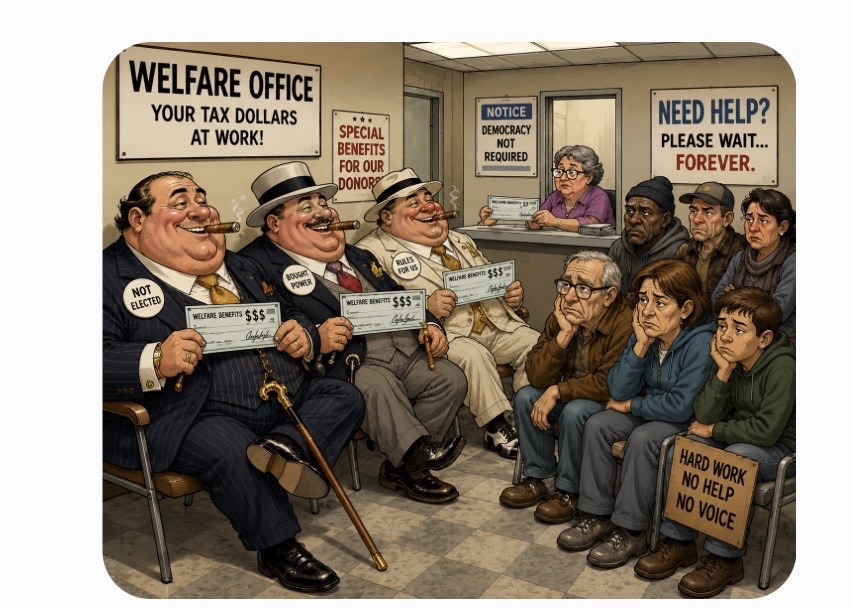
Political science experts and social commentators have long debated whether oligarchy or political apathy is the greater threat to democracy, but they are, generally, viewed as parts of a dangerous feedback loop rather than mutually exclusive issues. Oligarchy concentrates power and resources for the very few within a larger society, while political apathy by the many leaves that concentration in the hands of the powerful few, unchecked, thus allowing democratic institutions to erode. I would dare say that the outcomes sought after and obtained by oligarchs were premeditated, but that those of the political cynics or the politically apathetic were largely unintended. By not engaging in the political process they, still, whether they recognized it or not, contributed to that process and to its outcomes, one way or another.
It has been oft reported that voter apathy in Jamaica, for example, over the period of a decade, has reached historic highs, with general election turnouts dropping from historical averages which were over 60% of registered voters down to approximately 37.36% in the year 2020, and stagnating around 39.5% in the subsequent national electoral cycles. Similarly, Local Government Elections saw a turnout drop to just 29.6% of registered voters. And although the reasons for voter apathy vary, there is, no doubt, many who did not vote who are quick to blame this administration or that administration for their current woes in life. But, such people cannot have their cake and eat it. They must embrace the fact that by not having cast a vote that they, tacitly, have contributed to the very problems which they now face. Within the United States, in another instance, 36% of registered voters did not cast a ballot in the general election of 2024 – an estimated 89,000,000 people in the electorate. Again, there are various reasons for voter apathy, and there is, no doubt, that political cynicism was one of them. But, you cannot have your cake and eat it. Whether you are for or against something, let your voice, therefore, be heard.
The most famous issue in Jamaican history which was decided by a single parliamentary vote was the island’s departure from the West Indies Federation. In 1961, a national referendum was held, and Jamaicans voted 256,635 to 217,319 to leave the federation, paving the way for full independence in 1962. In the 2016 General Elections the Jamaica Labour Party (JLP) won the general election by the narrowest of majorities in the House of Representatives. They secured 32 of the 63 seats, giving them a one-seat edge over the People’s National Party (PNP). And throughout the history of the Jamaican Parliament, specific motions, committee reports, and leadership challenges have occasionally been determined by a single vote during floor proceedings. So, let your voice be heard, please.
In 1849, California drafted its first state constitution, and the question of slavery was fiercely debated. Delegates at the constitutional convention were deeply divided, with some advocating for California to become a slave state due to its agricultural potential. A single vote ultimately determined that California would enter the Union as a free state, tipping the balance of power between free and slave states in the U.S. Senate. So, let your voice be heard, please.
Adolf Hitler’s rise to power hinged on a critical vote in the German Reichstag in 1933. The Enabling Act, which effectively gave Hitler dictatorial powers, passed by a narrow margin, with a single vote tipping the scales. This act allowed Hitler to bypass parliamentary processes, consolidate his control, and implement policies without checks or balances. The deciding vote came from the Center Party, whose support was secured after Hitler promised to protect religious freedoms—a promise he quickly broke. Let your voice be heard.
During the Cuban Missile Crisis, Soviet naval officer Vasili Arkhipov cast a critical vote that prevented the launch of nuclear torpedoes from a submarine targeted by American forces. Under intense pressure, the submarine’s captain and political officer both supported firing, believing that war had already begun. Protocol required unanimous consent from all three officers, and Arkhipov’s dissent halted the launch. His refusal to escalate the situation came despite the submarine being harassed by American depth charges, which had pushed its crew to the brink of panic.
Arkhipov’s decision likely averted catastrophic nuclear conflict, as the torpedoes would have triggered retaliation and a full-scale war between the U.S. and the Soviet Union. His actions went unrecognized for decades, but historians now regard him as one of the key figures who saved humanity from annihilation. The incident underscores the fragility of global peace during the Cold War and the profound responsibility of individual decision-makers in moments of crisis. Do not just vent – please vote!
Some of you, my readers, might be of the opinion that political cynicism does not describe your own attitude in the least. But before you dismiss it altogether, please ask yourself the following questions. “Am I the sort of person who holds an entrenched, sweeping belief that all politicians are corrupt liars, and that the political system is entirely broken—despite any evidence to the contrary?” “Do I assume that all political actions are motivated strictly by self-interest and deceit, regardless of individual outcomes?” “Do I experience feelings of powerlessness which have led me to disengage from voting or from civic participation?” And “Do I believe that hidden, powerful elites are constantly manipulating all systems of government?” If you answered in the affirmative to one or to all such questions then you are, more than likely, what the experts call a political cynic. You would, therefore, be placing yourself and others in very dangerous situations. The Christian Bible says that nobody lives nor dies to self. Dr. Martin Luther King, Jr. was right when he said that, “We are all caught in an inescapable network of mutuality, tied in a single garment of destiny.”
And yet, another question which I would urge you to ask yourself is the following, especially you who are in the United States – “Am I being manipulated into thinking the way that I now do?” Partisan think tanks frequently leverage political cynicism to shape voting behavior. By funding research and communication strategies that frame opposing institutions as hopelessly corrupt, these organizations seek to mobilize their own base through outrage, while, simultaneously, depressing turnout among their opponents’ likely voters. Think tanks act as key information intermediaries that influence the American political landscape. While traditional research institutes focus on policy analysis, highly partisan groups frequently use communication campaigns which were designed to foster factual and normative disagreements. Research shows that by deliberately eroding trust in government, in media, and in electoral systems, these elite messages influence how citizens interpret scandals and assess candidates. Are you being manipulated? Are your thoughts your own or somebody else’s?
The consensus among political and social science experts is that political cynicism can cause voters to make unwise decisions or to vote against their own material interests. When citizens believe that the system is fundamentally corrupt, they are more susceptible to misinformation and they may support candidates simply to punish the establishment or “see their enemies suffer”, rather than based on policy. Research shows that highly cynical voters may support openly corrupt candidates. They do this to punish a system which they view as “rigged” or to ensure that bad policies are held accountable. Cynicism often fuels anger, which can cause voters to support challengers or extreme platforms without fully considering the practical consequences of those policies on their daily lives. Again, many cynics conclude that all politicians are the same and that their vote will not matter, leading to active disengagement or boycotting the election. This cedes political control to motivated minority groups. Ultimately, political despair can create a vicious cycle where hopelessness causes citizens to check out, thus creating an environment where the democratic process becomes even less accountable. Therefore, my friends, do not confuse political cynicism with political pragmatism. In the final analysis, it is wise to heed the following words penned by William Shakespeare:
“This above all: to thine own self be true, And it must follow, as the night the day, Thou canst not then be false to any.