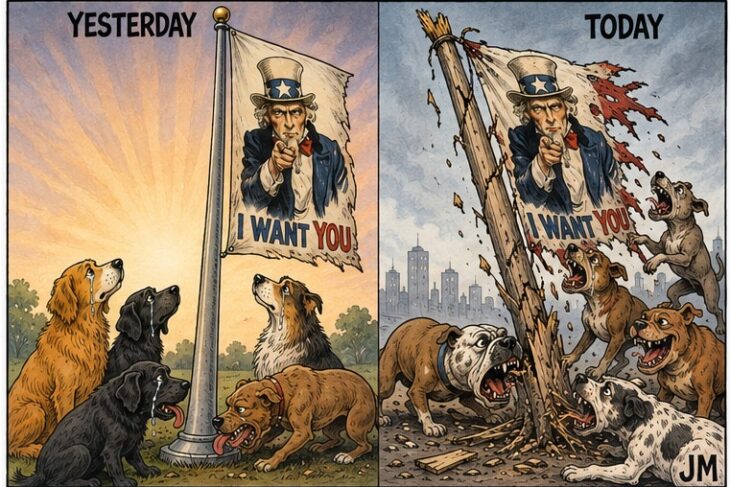
The title for this opinion piece came out of a discussion with my brother. It was he who had posited the idea from what he had obtained from another source. The thought was so intriguing that I indicated to him that I should try to tackle it, somehow, to flesh out the various ways in which it could be interpreted. And so, I began the process, but then soon suspended it because the substance of my research seemed to be at great variance with the theme of the title. This article is my second attempt.
One of the first things good writers do is to be clear on definitions. In this case, at least for me, the key term up for discussion, one enmeshed in the title, is the word, “evil”. It has been my custom to peruse various dictionaries and lexicons in that quest, also sociological and historical literature used to provide context in respect to word usage over time. Contexts I cannot avoid, but I am going to attempt to do something different in my approach on this matter. And I think I am going to take a chance by assuming that everyone understands the concept of appeal.
Again, in terms of providing definitions which would provide the platform for discussion on the topic at hand, the expression “twenty first century” appeared on my radar screen. How would I treat that in my discourse? My routine in an instance, such as this, would be to glean people’s understanding of the term “evil” from across centuries and cultures, and what, from within such boundaries, they deemed to be expressions of evil in their variegated social, cultural and political contexts. Of course this would demand an intellectual exercise of making comparisons and contrasts, before attempting to ascertain whether people were as much enthralled by the allure of evil or not from the past to the present.
Is there an overarching, universal and continuous aspect to everything and everyone that is defined as evil?
We are all grown-ups here, and so I am going to take another risk by assuming that all who read this opinion piece will agree that evil abounded in every era – regardless of perspective – whether from a culturally parochial or universal sense. People of yesteryear found appeal in people, in philosophies, in policies, in actions and in systems which now, if not then, are recognized as universally evil. And, if there is consensus on that, then does it follow, logically, that such appeal in respect to evil persists today in the 21st-century? Furthermore, if my reading between the lines of the thought which prompted the fashioning of the title is correct, it was expressed with a view that civilization of today, as we have come to understand it, infers a maturity, a development, or a refinement which older civilizations did not possess. Does evil still exist, and does it retain the power of appeal? If this is the case, then one would be able to appreciate the injection of any expression which is akin to amazement about its continuance against the backdrop of modern civilization’s vaunted boast of achieved sophistication.
What is evil for some is not always viewed as evil by others, and so the question of appeal is going to engender responses in different forms. And let me, for a moment, use Black people as a segue into this brief discussion. I am, as a Black man, who does not have a criminal record whether in my native country, Jamaica, or in my adoptive country, the U.S.A., is still, nevertheless, seen and treated as evil and as being the product of evil by many whites. I am even seen as evil by people who have never even met me. And so, anything that I might love with African origins, or anyone who is white who might share the same passion as I do, are viewed as being not only attracted to evil, but as being, automatically, evil.
The historical consensus, despite such sentiments against me and anyone who looks like me, is that 19th-century race scientists and theorists falsely argued that different races represented separate species, categorizing Black individuals as less evolved or closer to animals in order to justify their enslavement and their colonization. Because my ancestors were seen as “evil” in that regard, those were apt prescriptions for their punishment. And anyone who signed on to enforce such policies were, therefore, engaged in warfare against evil. Colonial administrators and segregationists frequently framed African and Indigenous societies as “uncivilized” or as morally corrupt, using paternalistic arguments that European rule was necessary to impose order on inherently chaotic populations. The world now knows of this moral inversion, where what appealed to people as good was actually evil, and what was deemed as evil was verifiably good. This is no different from what we learned about the Nazis and their mistreatment of Jews and other minorities during World War II. There are people and systems in the 21st-century still dealing with issues out of that archaic paradigm. And so, what is the mindset of such people today? Why does what the wider world see as evil attract them as something good?
I have definite opinions on what constitutes evil. But, I must admit that within the whole scheme of things that they are purely subjective and would remain so even if I cite the Christian Bible as a basis for them. So, let me be as one blinded by the bright lights of naivety, willing to defer to what others are saying is good and attracted to as good which the rest of the world views as evil. In that vein, I submitted the following question to an Artificial Intelligence search engine, “Which policies and practices are viewed as good by their proponents which are viewed by a large portion of the world in the 21st-century as evil?”
According to the AI search engine there are several 21st-century policies and practices which are defended as necessary security or economic measures by their proponents which are widely condemned, internationally, as human rights abuses or systemic evils. Most notably among them it highlighted such things asmass surveillance, as state-enforced border deterrence, and as preventive military interventions. In terms of the issue of mass surveillance and digital control some governments argue that large-scale data collection, facial recognition, and internet monitoring are vital tools to maintain public safety, to prevent terrorism, and to combat crime. However, a large portion of the world views these practices as authoritarian overreach that destroys privacy, that suppresses dissent, and that enables totalitarian social control.
On the matter of aggressive border deterrence and migrant detention, proponents of this subject assert that wealthy nations implement offshore processing, strict family separations, and indefinite detention policies in order to protect national sovereignty, to deter illegal entry, and to secure domestic labor markets. However, the global critique of this position coming from human rights organizations and international bodies condemn these policies as cruel, as dehumanizing, and as violations of the fundamental right to seek asylum. And on the subject of preventive war and unilateral intervention – while proponents of this policy assert a right to launch preemptive military strikes or regime-change operations in order to neutralize perceived security threats or so as to stop regional atrocities, critics frequently view these military actions as violations of international law, as destructive imperial aggression, and as a primary cause of massive civilian casualties and regional destabilization.
Having focused on policies and procedures I then reframed and submitted the following question with respect to public figures, in like manner, to the Artificial Intelligence search engine: “Which modern public figures are viewed as good by their proponents who are viewed by a large portion of the world in the 21st-century as evil?”
The following are the answers which it provided, which I will quote in large measure here: “Modern public figures who are deeply praised by their supporters yet viewed by many global critics as profoundly harmful or ‘evil’ include political leaders like Vladimir Putin, Benjamin Netanyahu, and Donald Trump. These individuals evoke intense, opposite reactions worldwide.” Let me repeat at this juncture, that these are not my subjective opinions but those which were generated by the AI search engine that is operated and maintained by Google. It is a massive technology company that runs the world’s most popular internet search engine, which makes the Android phone system, and which offers online tools like Gmail.
Furthermore, Artificial Intelligence works by combining natural language understanding, semantic vector search, and a process called Retrieval-Augmented Generation (RAG) to read the web live and then to write a direct answer. It replaces simple keyword matching with contextual interpretation to synthesize information from multiple sources.
All that having been said, the AI search engine went on to supply the following details surrounding the public figures it named, which again, so as not to be found guilty of subjectivism or of plagiarism I will quote again in large measure. Mr. Putin is “Seen by supporters in Russia and various nationalist movements globally as a strong leader defending traditional values, restoring national pride, and resisting Western hegemony.” He is, however, “Widely condemned across much of the international community for authoritarian governance, political crackdowns, and launching aggressive military actions like the invasion of Ukraine.” Of Mr. Netanyahu the system indicated that he was, ”Regarded by his base and many supporters in Israel as a vital, unyielding protector of the nation’s security against existential threats.” However, it went on to indicate that he is, ”Heavily denounced by international human rights groups, foreign critics, and domestic protestors for hardline military policies in Gaza, West Bank settlement expansion, and ongoing corruption charges.”
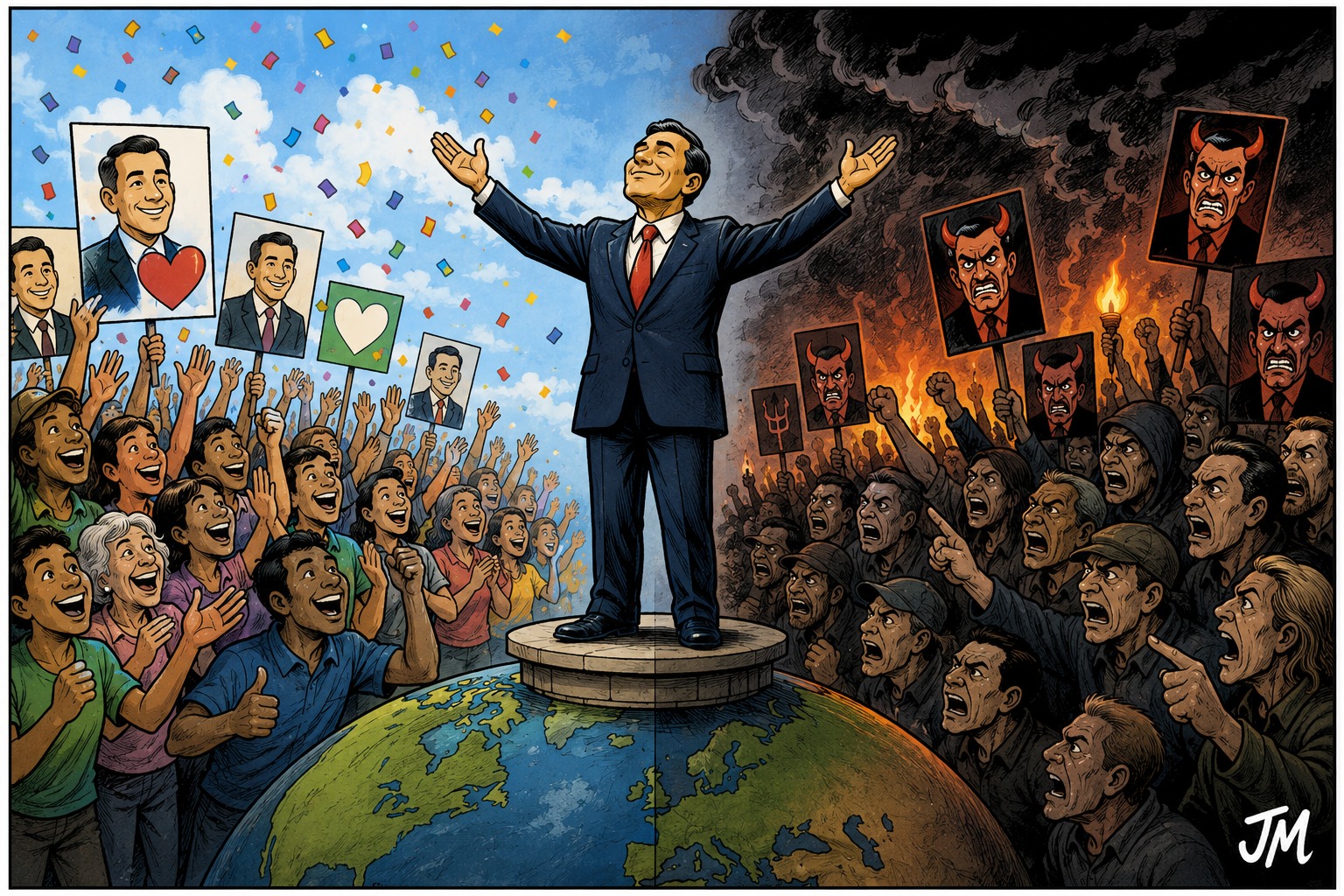
And last, but, by no means least, the system provided the following details on Mr. Trump, indicating that he has been, “Hailed by his followers as an anti-establishment populist fighting for the working class (‘America First’) and disrupting a corrupt political system.” However, from the points of view of his critics, he has been, “Viewed by large portions of the global community as a threat to democratic norms, international alliances, and global stability.” And so, depending upon one’s views as to what one deems to be good or evil is going to be reflected in the answers that one gives in respect to whether people are still being attracted to evil things and personalities in the 21st-century or not. Although the answers provided by AI might be regarded by most as being verifiably objective, it is, nonetheless, a collection and a collation of responses which express subjective and objective opinions from a wide cross-section of the global community, which is largely politically, socially and culturally pluralistic. And so it appears, that evil still appeals to many today. In closing, it was Lao Tzu, the legendary Chinese philosopher, born in 571 BC who said:
“When people see some things as beautiful, other things become ugly. When people see some things as good, other things become bad.”