I have been among some social commentators who have been advocating for stronger regional ties among our English-speaking Caribbean nations. This appeal was stirred up, in large measure, by the flexing of the diplomatic and of the military muscles of the current U.S. political directorate in the Caribbean region, in unprecedented fashion. And whether for good reasons or ill, the responses given by some of our leaders to such movements have been tepid, timid and tantamount to those of woeful acquiescence. I must admit that although I have been critical of what our leaders have felt obliged to do to support U.S. foreign policy in the region – aspects of it that many Americans neither understand nor agree with – they lead third world nations with certain vulnerabilities which many first world countries do not have. The U.S., as powerful as she is, has its own vulnerabilities. And, yet she is not so weak that she is still not able, in the following words popularized by Teddy Roosevelt, to “Speak softly and carry a big stick”. We in the Caribbean, with few exceptions, have tended to speak softly, even on matters which greatly anger us, precisely because we do not have the wherewithal of a big stick. And so criticism of our leaders, I believe, should be tempered by sage reality. Unlike them, during private negotiations, I was not in the room.
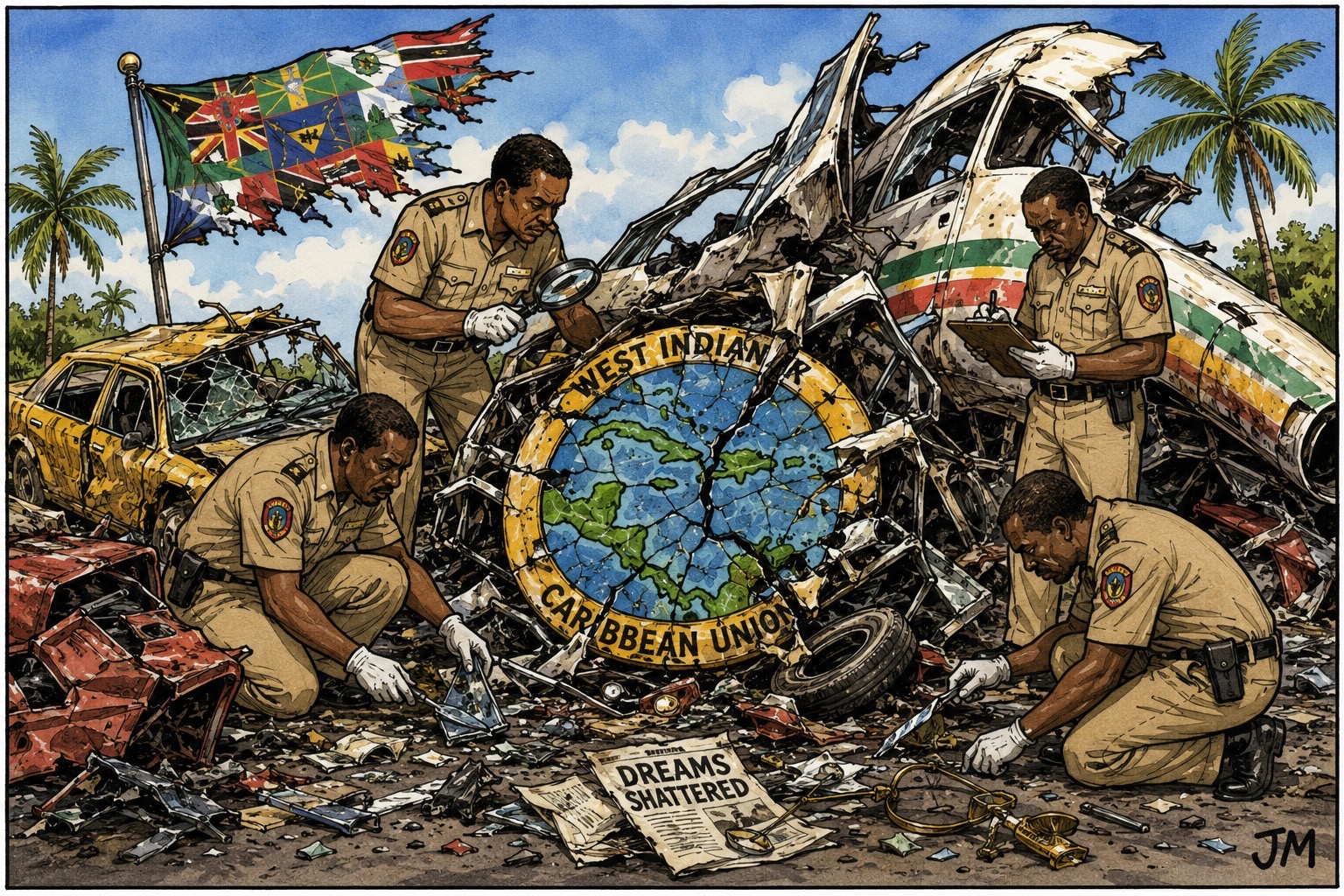
Although I am still a staunch advocate of greater Caribbean regionalism, I am still, in many respects, a newcomer to this thought process which is akin to that which inspired the now defunct West Indies Federation, which saw Sir Grantley Adams of Barbados become the first and only Prime Minister of that political system. Having joined the call today for greater regionalism, for such small nations as ours to better face the many difficult and besetting challenges of the modern world, I felt compelled to revisit the wreckage of West Indies Federation. From the pages of history I wanted to know what caused the crash? Was it pilot error? Was it a systemic failure? Was it a combination of the two? Or, despite having the best of everything to make such a launch possible, was it overshadowed by inclement weather which blew in from the outside and made it difficult to survive? What was the hole in the proverbial bucket, and is there still such a hole in the bucket, dear Liza, dear Liza? And from what I have been reading from history and observing in the Caribbean today I, verily, believe that certain problems which had beset us then still beset us now, to varying degrees. In fact, in light of what I have read so far, I am greatly amazed that we still have CARICOM – with all that it stands for, with all the benefits that it offers, and with all of the hope that it portends for the region. And, like one among investigators at a tragic crash site, I am now, slowly and carefully picking through rubble trying to find answers which might be of tremendous assistance to us.
As I have been looking through the wreckage, for example, I discovered that some within the Caribbean leadership would have been content with a weak central government. From the Jamaican perspective it has been the tendency to lay blame, squarely, at the feet of Sir Alexander Bustamante for his activities which led to the exit of the country from the Federation and to its eventual demise. He was clear that he was not in support of it. But, on the other hand, Mr. Norman Manley, who was in support of it, wanted a, relatively, weak central government, which placed him at odds with Mr. Eric Williams of Trinidad who saw the need for a strong one. In fact, when Sir Grantley Adams tried to argue for the increase of the Federal budget Mr. Manley, in protest, threatened to pull Jamaica out on account of it. And, so, outside of the bickering that took place as to where the Federal capital should be established, disagreement over the strength of the central government, which included what roles and responsibilities it should play as against what roles would be reserved to the individual territories, was also at issue. This piece of evidence was a major cause for the collapse.
As the size and nature of the central government were among other factors which could be identified as systemic, there were other concerns which lingered in the hearts and in the minds of the political elites across the region. In Jamaica again, for example, which, along with Trinidad, was seen as one of the larger and richer nations, both Sir Alexander Bustamante and Mr. Norman Manley shared concerns about how the smaller and poorer territories, not possessing, for example, such a natural resource as bauxite, would negatively impact the economic progress that Jamaica had made at the time. And although, like Trinidad, which had oil and natural gas, she had a much larger population than those within the smaller territories, her representation in the West Indies Federal parliament was not reflected in that regard. In fact, of the ten territories represented in the cabinet, eight of them were assumed by officials from the smaller poorer ones. Again, as the larger, richer territories had concerns about such political influence as it was being wielded by the smaller poorer ones, the smaller islands feared possible abuse from the larger ones. And as was the case in Trinidad, there were concerns that migration from the smaller territories would exacerbate her struggles with over-population, in tandem with the scarcity of arable land. Such concerns were not petty, but they were, nonetheless, divisive.
Although all the territories shared a long history of British imperialism, colonialism, African slavery and Asian indentured labor, they had developed, nonetheless, unique cultures. These cultures not only shaped the ways how people saw themselves within their respective geographic domains, but also how they viewed others in those islands foreign to them. It goes without saying that with such parochial perspectives there was going to be inevitable biases. And although it is possible and it is healthy to appreciate the differences we have with others, even in fun-filled rivalries, such differences can and often develop into various iterations of social and cultural toxicity. Most times such prejudices come to light on the wings of words which have been uttered. In the book, The West Indies Federation, edited by David Lowenthal, published in 1961 by the American Geographical Society, the following illustrates, I believe, the point that I am trying to make:
“For Barbados, federation now poses fewer special problems than for any other territory. This is a consequence partly of Barbados’s intermediate size, partly of her position as headquarters for inter-island trade, partly of the fact that, as one Barbadian journalist put it, ‘most Barbadians tend to regard the Federal government as specifically theirs because of the leadership of their own Sir Grantley Adams as Federal Prime Minister.’ Adams is an astute politician. But he continues on many occasions to speak from the Barbadian viewpoint rather than from that of The West Indies. ‘Barbadians are the most intelligent and industrious people in the West Indies,’ he remarked, in a speech in New York late in 1959: ‘Trinidadians prefer to sing calypsoes than to work. Fifty percent of Jamaica is illiterate.’”
My research is on-going. Discouragement has been at my elbows. But then I look up at CARICOM, and I look out at the many regional entities which exist today, and all these continue to give me hope. Despite the wreckage, there are not only signs of life, but clues as to how we as a region can do things differently, and efficaciously better. Could the formation of former Caribbean British territories into a federation today succeed where the old one did not and how? The consensus is as follows. A modern political federation of former British Caribbean territories could succeed where the original West Indies Federation of 1958-1962 had failed, but only through a gradual, bottom-up economic and functional integration rather than through an imposed political union. Success depends on leveraging existing frameworks like the Caribbean Community (CARICOM), by establishing robust mechanisms for shared revenue, and by building deep public trust.
Before looking at possible solutions, a brief recap of why the original Federation failed is, I think, quite in order. It failed because of the top-down way it was introduced by Britain. The imperial government had created the 1958 union to fast-track decolonization, leaving local leaders and populations with little ownership or emotional buy-in. It failed because of the intense political rivalries between major figures in Jamaica and in Trinidad and Tobago which caused friction over resource allocation and where to place the federal capital. It failed because
wealth and population were heavily concentrated in just a few islands, leading smaller territories to fear dominance and larger ones, like Jamaica, which voted to exit in 1961, to feel financially burdened.
A modern Federation, on the other hand, could succeed through incremental integration. Instead of an instant political merger, the region must build upon existing models like the Organization of Eastern Caribbean States (OECS), and the CARICOM Single Market and Economy (CSME), and by normalizing cross-border freedom of movement and shared currency systems first. There must also be equitable revenue sharing. A modern framework needs explicit, legally binding fiscal transfers and development funds to protect smaller island economies, thus ensuring that the wealth generated by larger resource-rich members, like Trinidad’s energy sector, benefits the entire union.
CARICOM member states would need to maintain absolute national sovereignty and independent governance, whereas in a federation it would require individual states to surrender core legislative and executive powers to a central federal government. CARICOM functions through consensus via the Conference of Heads of Government, bypassing the centralized parliamentary control systems characteristic of a federal state. These are among the crucial issues which need to be considered.
And, finally, unlike the colonial-era blueprint, a successful 21st-century federation would require sustained public education, referendums, and institutional backing from bodies like the University of the West Indies in order to foster a unified Caribbean identity that overrides insular nationalisms. I was not a product of the University of the West Indies (UWI), but I will close this essay with its motto, in hope, as if I were one of her very own, “Oriens Ex Occidente Lux,” which translates from Latin to, “A Light Rising from the West”.