Education literally means to lead toward learning, involving the
transmission of knowledge and skills. In its most effective application,
however, education involves both nurturing and instruction.
In this era of standardized testing and increasing attention to financial
concerns, I often wonder whether those in the classroom are able to
practice the most effective pedagogy — one that is both nurturing and
instructional. When I read reports from administrative leaders, the
emphasis on test results, spending ratios, and cost per pupil overlooks
vital aspects of an advancing pedagogy of learning.
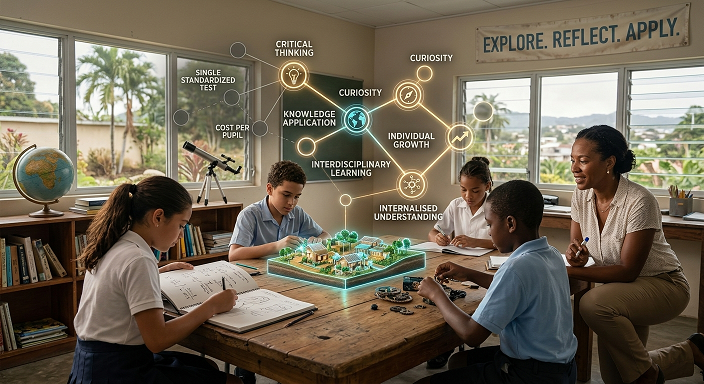
The current attempt to apply a business model to education — with
standardised texts followed by testing for specific skills and facts — can
miss an essential component of knowledge: the ability to apply
understanding to practical situations, experience personal growth, and
ignite curiosity. Classrooms certainly need time and commitment to
expose learners to texts and essential knowledge, but they also need to
provide meaningful contexts and practical situations in which students
can explore the world around them. The resulting knowledge should
become tacit — something understood and internalised — not simply
something that can be measured on a test.
The most effective lessons involve pedagogy that guides meaningful
exploration and provides holistic exposure. Every student should have
opportunities to become immersed in experiences that lead to greater
awareness and understanding of the world, while recognising that each
learner brings a unique personality, set of interests, and range of
abilities to the process.
This kind of learning cannot be fully captured in a 50-minute test in
which everyone is expected to reflect the same basic information.
Standardised assessments may provide useful information, but at
best they offer a limited snapshot of a learner’s development. True
education recognises that each of us takes something uniquely personal
from our exposure to knowledge, facts, ideas, and the application of
skills.
Adventurous teachers provide some of the most creative and fulfilling
learning experiences because they are willing to combine skills and
knowledge across disciplines. A history lesson, for example, can provide
exposure not only to historical facts but also to mathematics, art,
music, philosophy, reading, and writing. Learning becomes
interconnected rather than divided into isolated subjects.
Consider a struggling reader who is given a recipe or a science
experiment to decipher. Curiosity can pull that student into reading and
mathematics in ways that a conventional exercise may not. The student
must follow simple or complex instructions, interpret predictable
language, and apply mathematics to a meaningful task. Measurement,
multiplication, division, addition, and subtraction can all be embedded
naturally within the activity.
Advanced learners, too, thrive when they are given challenges that
push them toward the limits of their abilities. Asking students to
explore multiple sources and varied perspectives gives them invaluable
tools for personal growth and independent learning. In their search for
understanding and truth, they encounter problems that require critical
thinking, the acquisition of specific knowledge, and an appreciation of
possibilities they may not have previously considered.
A highly qualified teacher understands the importance of designing
instruction that engages the curiosity of learners with a wide variety of
abilities and needs. When students are asked to examine their physical
environment or situations presented through different resources, they
can discover what confirms or challenges their predictions about reality
and draw meaningful conclusions. Learning for a lifetime takes both
time and curiosity.
Teachers who understand the importance of timely instruction can use
strategies such as mini-lessons, study circles, and written reflections to
reveal the individual stories of learning. Short lessons tailored to a
student’s question can be extraordinarily powerful. I remember
teaching in a classroom of approximately 50 students in Jamaica when
one student asked me how to represent conversation in a story she was
writing. As I explained the use of quotation marks, a group of curious
students gathered around us. Before long, other students were
experimenting with quotation marks and incorporating dialogue into
their own stories. One student’s question became a lesson for many.
Some of the most successful lessons I have used involved study groups
and literature circles in which learners could explore their own
meanings and make personal connections. I knew they were learning
because, ultimately, they demonstrated that learning through projects,
presentations, and the application of knowledge. At one point I was
also able to incorporate portfolios that students created to
demonstrate their learning and to express what they considered most
important. Evaluating the portfolios alongside their personal reflections
provided a much richer and more honest representation of learning
than a single test could provide.
There is no magic bullet for teaching and learning. There are, however,
ways to strengthen the connections that students carry with them long
after they leave the classroom.
If the purpose of education is truly to develop knowledge and skills
within a nurturing environment, then we should be cautious about
reducing learning to sound bites of information that can be easily
tested and measured. We need to place greater emphasis on practical
application, exploration, curiosity, reflection, and the individual growth
of the learner.
Education should not simply ask: What does the student know? It
should also ask what does the student understand? What can the
student do with that understanding? What questions has the learning
inspired? And how has the experience changed the way the student
sees the world?