
“Until philosophers are kings, or the kings and princes of this world have
the spirit and power of philosophy, and political greatness and wisdom
meet in one, and those commoner natures who pursue either to the
exclusion of the other are compelled to stand aside, cities will never have
rest from their evils — no, nor the human race, as I believe — and then
only will this our State have a possibility of life and behold the light of
day.” — Plato
Whether one chose to agree or to disagree with him, or whether one
found it easier to dislike than to like him — nobody, in all sincerity and
in all fairness, could assert that former Prime Minister of Jamaica, the
Honourable Michael Manley, was a politician who was short on ideas in
respect to the public interest. And, even if the following words from the
campaign slogan of a political rival of his, “It takes cash to care”,
suggested that his approach to solving Jamaica’s political and economic
problems was quixotic in nature, no one could, again, dispute his
genuine love nor question his unswerving commitment to the people of
Jamaica.
But, conversely, it can be said that the tumultuous times surrounding his
tenure in office did see many become disaffected with his policies and
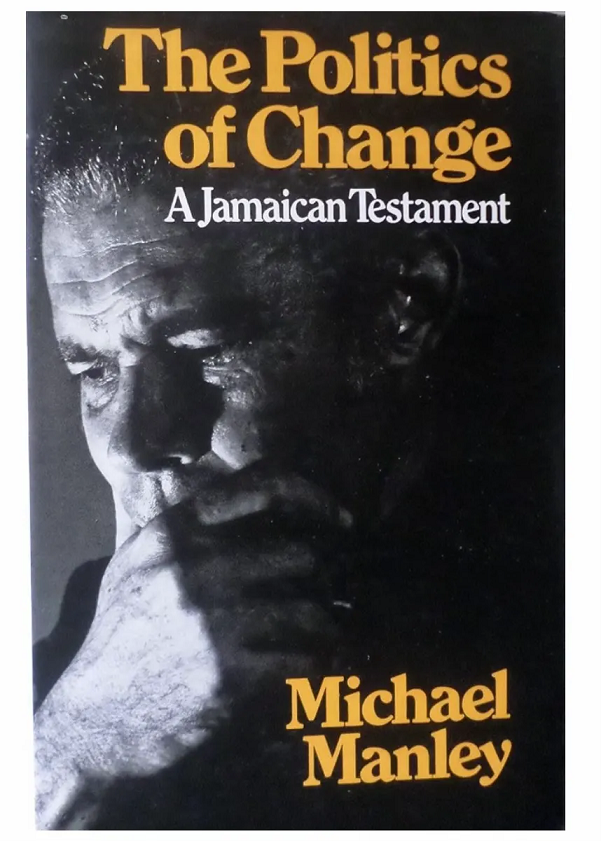
even with the man himself. And so, what of his book, The Politics of
Change? What of his ideas?
The sentiments expressed by this writer in the introduction of this
opinion piece came about despite certain negative biases which he had
developed in respect to Mr. Manley and to the People’s National Party
(PNP) of that era.
When Mr. Manley assumed office during his first term in early 1972 this
writer was just entering his teenage years. If memory serves correctly,
he saw Mr. Manley, for the first time, in-person, when he had delivered
an address at his high school’s prize giving ceremony during the
following year — 1973. Politically speaking, this writer was a young,
immature, blank canvas. Although his parents kept abreast of things
political, those were not topics discussed with their two sons, in keeping
with the philosophy that “children must be seen and not heard”.
And so this writer’s first sighting of the Prime Minister was as one
caught up in a moment of euphoria, the same way that he had been
when he stood on the same landing, of perhaps a school, as the then
Prime Minister, the Honourable Hugh Shearer, who had delivered a
speech to a gathering before he left by helicopter, the same way that he
had come. This writer had often mimicked the oratory of both men
while he was among his peers in jest.
In 1974 when The Politics of Change was published, this writer had
turned 15 years old, and it was in November of that same year that Mr.
Manley declared his regime as Democratic Socialist. Being caught up in
the charisma of the leader, this writer soon experienced a political
awakening, but in a less serious and more romantic sense.
The Budget Debates in Gordon House with the Prime Minister’s oratory,
along with public addresses which he had made on television and on
radio, were, simply, as captivating as they were entertaining. This writer
did take a keen interest in a booklet that was published which was an
attempt to explain the PNP’s version of Democratic Socialism. He also
had his version of bush jackets, a style which had become popular at
that time through Mr. Manley, in an attempt at copying and at trying to
exhibit the leader’s snazzy appearance in his iconic Kariba suits,
garments that this writer still regard with fondness today.
And then, in 1975, when this writer had turned 16 years old, Pluto
Shervington wrote and released a song with lyrics which were indicative
of growing changes within the Jamaican society towards the policies of
Mr. Manley and his PNP Government:
One more Jamaican gaan abroad
One more disciple leave the yard
But if you think sir we are ‘gus stand up and wait
No way while we hold the gate for yu
No think so at all
[Chorus]
But I man on ya, I man born ya
I nah leave ya fi go a Canada
No way sir, pot a bwayl ya, belly full ya
Sweet Jamaica
In 1976 this writer sang with his high school choir at a CARIFESTA
function held at Jamaica House. Again, he saw Mr. Manley up close,
gazing at him, admiringly, as some of the girls on the choir, in costume,
flocked around the leader, giggling, smiling from ear to ear, with one of
them saying, effusively, “My Prime Minister”. That year this writer
turned 17 years old. As Pluto Shervington’s song served, in a sense, as a
barometer of negative change towards the Manley regime, this writer,
based upon what he was observing in society at that time, just as a
young, normal citizen, was, himself, becoming disaffected with what
was happening on the political scene, and the Jamaica Labour Party
(JLP) was not conducting itself in a manner to win his allegiance either.
The Green Bay Massacre of 1978 really incensed him, especially as
nobody in the military who slaughtered those unarmed JLP supporters
was found criminally responsible for their deaths. And the assertion
made then, by the Minister of National Security, that the victims were
not at all innocent, did not help matters. This writer had turned 19 years
old that year. In 1979 he left for the United States to attend university.
He had not read The Politics of Change before he had departed,
nor hadhe done so while he had come across copies of the book in the
university library. That was not done out of malice, as he had other
interests that were, for him, far more pressing and sublime at that stage
in his life.
And then came the straw that broke the Camel’s back during the bloody
violence of the 1980 General Elections. A lovely girl by the name of
Annette, a schoolmate from high school, was slaughtered along with
other members of her family. This writer developed, as a result, a
seething hatred for all politicians, regardless on which side of Gordon
House they sat. He was 21 years old when he saw Annette’s face in the
newspapers. He blamed the Honourable Edward Seaga for introducing
gun violence into our local politics as he did Mr. Manley for trying to
match him in that respect. And, he had not read The Politics of Change,
with more reason then not to have done so.
But, “things and times change”, as they say, and if that statement is
fallacious, then, for sure, in some respects, this writer did change. And,
so, his commendations in respect to Mr. Manley’s intellect and as to his
love for his country, at the outset, were not at all made lightly. That
being said, what now of Mr. Manley’s, The Politics of Change?
The publication, which appears to be out of print — hence quite rare
and oft prohibitively expensive — is not an intimidating tome replete
with scholastic pedantries nor with superficial vagaries. It was well
researched and couched in language that was understandable in
eloquent Manley-esque style, reminiscent of that used by him in his
public speeches.
This writer does not believe, as was suggested many years ago by an
eminent civil servant who worked in the Department of Statistics, one
now deceased, that Mr. Manley lacked the acumen to produce such
work, based upon her encounters with him, and despite him having
been a graduate of the London School of Economics. It reminded this
writer of the leader’s command of the English language and of factual
details when he spoke off the cuff in myriad interviews which he did
with journalists — both domestic and foreign based. He was, therefore,
in this writer’s opinion, of the ilk of the philosopher king that Plato
wrote about, but one, regretfully, who was flawed, and therefore prone
to errors in judgement and in the application of ideas. But do failures
always accurately define a person and obscure his or her true
intentions, ultimately?
One has to be careful to be quite discerning and not to be too quick and
cavalier in judging other people’s intelligence and their history,
something that this writer witnesses today in the modern workplace.
Who knew, for example, that Mr. Michael Manley served in the Royal
Canadian Air Force (RCAF) during World War II? Who knew that
after finishing school, he joined the RCAF and attained the rank of pilot
officer before leaving the service at the end of the war? Who knew that
following his military service, he went on to study at the London School
of Economics before, eventually, becoming the Prime Minister of
Jamaica?
And what of the man who staunchly advocated for increased job
creation; for greater worker participation in the workplace; for the
strengthening of local government; for greater national economic
independence through diversification of production and increased
exports as against imports; for a lessening of the gap between the rich
and the poor; for a release from psychological inferiority which was
brought on by the ravages of colonialism; for access to an integrated
educational system, which he saw as crucial to building self-reliance, for
every Jamaican regardless of race, gender, social and economic status;
and for a more just and egalitarian society? Was he a philosopher king
or was he just another demagogue?
All that having been said, were the ideas expressed in The Politics of
Change, based upon some of the disappointing outcomes of Mr.
Manley’s policies, though noble, refreshing, and still quite relevant
today — reflections of boldface lies, of subtle half-truths, or of quixotic
missed-steps on his part?
Like so many in Jamaica and in the diaspora this writer has many
questions in that regard. Books critical of the man and of his regime
were published. No doubt, there were things asserted which are
impossible to gainsay. But this writer is of the humble opinion that there
were good intentions, some of which many Jamaicans are benefiting
from today. And, in respect to Mr. Manley and his ideas, in closing, the
following words from another controversial leader of, perhaps, Mr.
Manley’s ilk, from American history, in the person of Teddy Roosevelt,
who, long before, had fought for a fair deal for the working man
through his domestic programmr known as the Square Deal, might
suffice:
“It is not the critic who counts; not the man who points out how the
strong man stumbles, or where the doer of deeds could have done them
better. The credit belongs to the man who is actually in the arena, whose
face is marred by dust and sweat and blood; who strives valiantly; who
errs, who comes short again and again, because there is no effort
without error and shortcoming; but who does actually strive to do the
deeds; who knows great enthusiasms, the great devotions; who spends
himself in a worthy cause; who at the best knows in the end the triumph
of high achievement, and who at the worst, if he fails, at least fails while
daring greatly, so that his place shall never be with those cold and timid
souls who neither know victory nor defeat.”