From I was a youngster in high school, I found it strange that under our approach to education, knowledge of the human body was treated as an optional subject rather than a required course of study. I felt that our bodies were the one constant in each of our lives and we ought to have some understanding of how it functions. This ignorance, as well as the persistent poverty among so many of our citizens, are no doubt largely responsible for the overburdened public health systems we experience year after year across Jamaica.
Several years ago, I was chatting with my friend the late journalist and playwright Barbara Gloudon, and the issue of health care came up. I remember her saying, “Carl, do you realize that it doesn’t matter how much you save or put aside, all it takes for you to go penniless and destitute in Jamaica, is one major illness?” Another attorney friend of mine who was forced to fly her sick daughter out via air-taxi shared similar sentiments. She was forced to pretty much start over financially because of her experience. One of my long-held wishes for Jamaica, is that the authorities (education and otherwise) really see the link between health education and health care. Without this basic appreciation, we will NEVER have sufficient resources to support the already ramshackle health institutions we call hospitals. As a matter of fact, nothing else we do as a nation is important if the majority of the society is unhealthy! As far as I am concerned, one of our main health issues is mental. This is the reason why so many of us so “dark an ignorant”. If we take this phenomenon seriously, we may just stem the senseless violence we witness across the country daily!
The harsh reality is that it is more costly to have to deal with illness than wellness. Research has shown that approximately 30 per cent of deaths per year in Jamaica are related to heart disease! In the USA, one person dies every 34 seconds from cardiovascular disease, according to their Centre for Disease Control (CDC).
I visited a dear friend of mine recently and he told me he was having challenges driving at night, so he went to his ophthalmologist, only to be told that he had cataract is both eyes. He was further advised by the doctor that it will cost J$500,000 per eye for the operation! How many Jamaicans, even those who have laboured all their life, can afford this?
The latest practice is that even if one can afford to go to a doctor in Jamaica, invariably at the end of the visit, the patient will be handed a collection of prescriptions to do a litany of tests which few are able to afford.
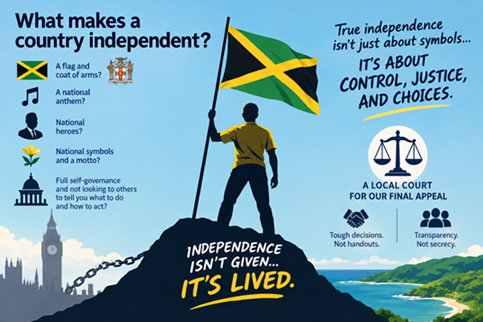
This brings me to the recent sad decision by the Jamaican government to terminate the 50-year agreement with the Cuban government to provide affordable health care to the Jamaican people, simply because the Americans bullied us into doing so. Are we really a serious independent sovereign nation? And the bullying Americans have yet to offer an alternative to this decades old and incredibly successful health care collaboration.
Throughout my life, I have had probably 3 or 4 medical doctors. As I became an adult, these have always been individuals I have a relationship with. It is absolutely a basic requirement. So much of what we undergo medically are personal and private and I MUST feel comfortable opening to another individual about this. In fact, if I cannot have an open and honest private discussion with you, how can you possibly help me heal?
A recent visit with my mom to the emergency unit at the University of The West Indies (UWI) and being exposed to so many medical staff in a 48-hour period there, exposes a significant weakness in our health system. Many patients attending public institutions have NO relationship with their attending physicians! Many do not even know the name of their doctors!! In fact, for the so-called health system, these patients are not humans, but files to be processed. Sad indeed. And so, the care component of the health care establishment often does not exist. If you think I’m joking, just ask the average Jamaican who attend a public health facility the name of their doctor and see how many can give you a name! Having to return to the UWI Accident and Emergency unit twice, I’m convinced that the only place where emergency exist at the unit, is on the outside entrance sign.
Despite this, as a country we have made some significant strides and can proudly stand heads and shoulders above some of the so-called 1st world nations on the globe. Some of the notable achievements that come to mind are:
- National Health Fund (NHF)- Thousands of Jamaicans with common health issues, can now get their prescriptions filled for free. Additionally, the Fund covers some of the cost of many critical medical tests and procedures.
- National Insurance Scheme (NIS)- Conceived and implemented in the 1960’s, with updates through the years, this landmark social security net is the mainstay of so many retired Jamaicans. Providing a level of health insurance in addition to a small monthly pension among other benefits, NIS has proved that government CAN work for the people if we insist on it.
Another constant that seems to plague the health sector in Jamaica is the lack of accountability among the various individuals and entities in the public sector, charged with administering it. From Cornwall Regional Hospital in the west to University Hospital in the east and so many other institutions in between, so much of our public expenditures are unaccounted for. And there seem to be no end to this in sight. And no individual is paying the price for the poor administration or at worst, corruption taking place at these institutions. As usual, in the end, the public suffers. Jamaica deserves better.
I had to visit the Kingston Public Hospital recently to collect something from a friend of mine who is a doctor and happens to work there. It was like entering a crowded, disorganised and congested, poorly kept market. Some patients were sitting around for days just waiting to be attended to by a medical practitioner. Many were sitting on the floor as there was not enough proper seating available. Yes, sadly, that is the current state of our premier Health Care facility.
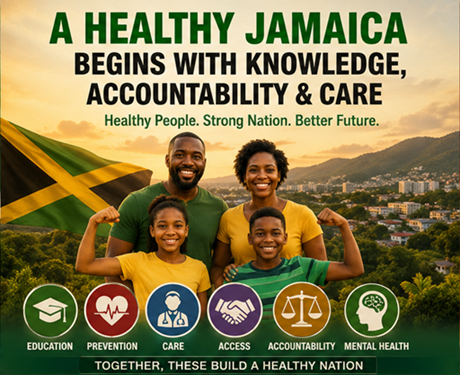
In conclusion, how do we approach the general HEALTH CARE of our people?
- This must start in the schools at the earliest levels. Health education must be a priority. Kids must be taught about their bodies. How it works; what to feed it to ensure maximum healthy outcomes.
- Another critical role for government is ensuring that our regulatory agencies are seriously monitoring imported fast-food enterprises, ensuring healthy inputs into their food processing for public consumption. It is not by chance that many European countries refuse to allow several American franchises from operating in their countries. The result is their citizens end up healthier for it! That level of scrutiny seems to be absent in Jamaica.
- And then: ACCOUNTABILITY! ACCOUNTABILITY! ACCOUNTABILITY!! Public servants found irresponsible and corrupt in the handling of public funds must pay a price.
And finally:
- I will return to a position I have held for decades, supported by some of our finest minds in the field of psychiatry. I refer to the late Professor Freddie Hickling, Professor Wendel Abel and the late Dr. Aggrey Irons. We need to pay more critical attention to mental health in the society. Many of the other lingering issues we face like crime and violence and our approaches to relationships, have a direct link.
In the final analysis, a vibrant, healthy economy and culture will demand and depends on a healthy populace.