“We Stand Tired And Tested
Our Hearts Resurrected
One Truth This Is What We Live And Die For
We Fight With Conviction
No Time For Excuses
One Life It’s Our Only Chance
To Take A Stand
Try To Make A Stand
Try To Make A Stand
Make The Most Of Every Day You Live
Choose The Day It Just Might Be Your Last
No Regrets We Have No Time To Wait
Take Control We’ve Got One Life To Live.”
- One Life To Live, (A song made popular by Lou Rawls in 1977)
This writer, having recently watched the movie, Pressure, which dealt with the decision made by General Dwight Eisenhower to launch the D-Day invasion in Europe, against the backdrop of the unpredictability of weather, thought of the many who died on the beaches of Normandy, in France, and elsewhere in Europe afterwards, and of those who perished in other bloody wars that America was involved in. He also thought of the appeals that were made by the various administrations for citizens to support war, even with their willingness to make the supreme sacrifice. This brought into focus the question of the importance, of the veracity, and of the reliability of what people are called upon to fight for in the national interest. Is it worth giving one’s life for in the service of one’s country which could be refuted and then abandoned later on?
Hence this writer’s reflection on the lyrics of the song, One Life To Live.
Throughout American history, the government and the media have used powerful slogans to unite citizens, to boost their morale, and to encourage their support for military conflicts. Those phrases appealed to their patriotism, to their sense of duty, and to their defense of freedom during major national crises. It is quite interesting to note how the government and the media attempted to condense political aims, policies and procedures into catch slogans akin to the one now in vogue, “Make America Great Again” (MAGA). This writer found the record of such slogans quite interesting, if, for no other reason than for their creativity. During the Revolutionary War and The War of 1812, for examples, the following slogans were bandied about among the populace: “Don’t Tread on Me”, which was used on the Gadsden flag, showing resistance to British control; “Join, or Die”, Benjamin Franklin’s famous political cartoon turned into a slogan, which urged the colonies to unite; and “Free Trade and Sailors’ Rights“, which was a rallying cry during the War of 1812 against British impressment.
During World War I the following slogans were part and parcel of the propaganda of that period, “Make the World Safe for Democracy”, which was President Woodrow Wilson’s stated reason for entering the war in 1917; “Keep the Home Fires Burning”, which had sought to encourage families to stay strong and to support the troops from afar; and“Food Will Win the War”, which was utilized in order to urge citizens to conserve food for soldiers. In World War II the slogan, “Remember Pearl Harbor”, sought to rally the nation to seek revenge against the Japanese and to support the fight after the 1941 attack;“Loose Lips Sink Ships”, which was used to warn citizens not to share secret information that could help their enemies; “Do with Less—so They’ll Have Enough”, which was used to encourage wartime rationing and sacrifice on the home front; and“Rosie the Riveter / We Can Do It!”, utilized in order to Inspire women to work in factories to build military supplies. And during the Cold War, American propaganda took on a religious tone in the following words, “In God We Trust”, words which were placed on U.S. money, and which made the national motto in 1956 in order to contrast the American way of life with godless communism. They were all catchy if not noble expressions, but were they worth fighting and dying for? Considering our political reversals seen today, it appears that many have died in vain.
About 360,000 to 365,000 Union soldiers died for democracy against the forces of oligarchy on American soil while in the service of the United States. They fought against a political ideology which centered on extreme states’ rights, specifically the absolute right of a state to nullify federal laws and to secede from the national compact. The explicit political and economic cornerstone of the Confederacy was to permanently protect and expand the enslavement of African Americans. Of the number of Union soldiers who died under the leadership of President Abraham Lincoln the records show that approximately 110,000 were killed in combat, with the rest dying from disease, from accidents, and while languishing in prison. The American Civil War lasted from April 12, 1861, to May 26, 1865.
About 116,516 Americans died during World War I. Of those deaths, 53,402 were from combat related activities, while 63,114 died from disease and from other non-combat causes, heavily driven by the 1918 influenza epidemic. American forces then fought against the political and the military alliance known as the Central Powers – an imperial coalition dominated by authoritarian monarchies and empires. World War I lasted from July 28, 1914, to November 11, 1918.
During World War II, a total of about 407,316 American service members lost their lives. This total includes 291,557 battle deaths and 115,759 non-battle deaths, such as those caused by accidents or through illness. The American soldiers fought, primarily, against the Axis Powers – a military alliance that was driven by highly authoritarian, expansionist, and totalitarian ideologies like Fascism, Nazism and Imperial Militarism.
Fascism was propagated, chiefly, by Benito Mussolini’s regime in Italy. It championed radical nationalism, totalitarian government control, and the suppression of political opposition by force. Nazism, which was led by Adolf Hitler in Germany, was a racially driven variation of fascism that combined extreme anti-Semitism, biological racism, aggressive militarism, and the pursuit of Lebensraum (i.e., living space) through territorial conquest.
Governed by a military-dominated regime, under Emperor Hirohito, Japan’s political force centered on fierce ultra-nationalism, on imperial expansion across Asia and the Pacific, and on the absolute subordination of the individual to the state. World War II, officially, began on September 1, 1939, with the invasion of Poland by Germany, and it ended on September 2, 1945, with the formal surrender of Japan, lasting a total of six years.
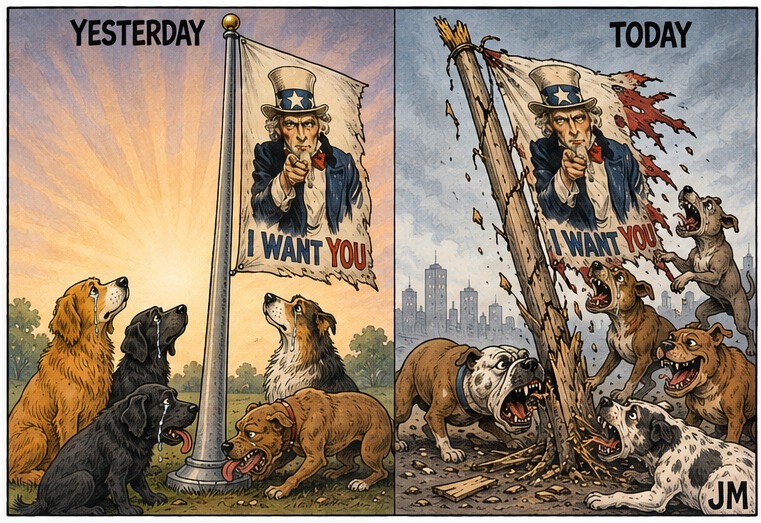
In November of 2024, almost 80,000,000 people within the United States voted, singularly and in principle, for all that their forebears had fought against and for which they died during the armed conflicts just mentioned. The current American directorate, in its quest to solve national and international problems – both real and invented – has been a reflection of the political ideological beliefs and practices which were manifested by the country’s enemies in those conflicts. A quest towards racial oppression, racism, anti-federalism, illegal international expansionism, militarism, absolute subordination of the individual to the state, the suppression of political opposition, and the control of vast resources in the hands of a small few is now the order of the day. And so, regardless of whatever justification was given for their votes, in principle, based upon what we are witnessing today, almost 80,000,000 Americans voted against what their forbears had shed their precious blood to prevent. It was Aeschylus who said that, “In war, truth is the first casualty.” And, it was George Orwell, who echoed similar sentiments, several centuries later, when he said that: “All the war-propaganda, all the screaming and lies and hatred, comes invariably from people who are not fighting.”
As poignant as the words of Aeschylus and of George Orwell are in respect to the delusion of war, perhaps the greatest tragedy of it all, particularly in the American context, is the patriotic amnesia of the 80,000,000 in the American electorate in respect to the following words which were uttered by President Abraham Lincoln, in his famous Gettysburg Address, as ground reserved for those who died in the Civil War in defense of American ideals was being dedicated:
“Four score and seven years ago our fathers brought forth on this continent, a new nation, conceived in Liberty, and dedicated to the proposition that all men are created equal. Now we are engaged in a great civil war, testing whether that nation, or any nation so conceived and so dedicated, can long endure.
We are met on a great battle-field of that war. We have come to dedicate a portion of that field, as a final resting place for those who here gave their lives that that nation might live. It is altogether fitting and proper that we should do this.
But, in a larger sense, we cannot dedicate – we cannot consecrate – we cannot hallow – this ground. The brave men, living and dead, who struggled here, have consecrated it, far above our poor power to add or detract. The world will little note, nor long remember what we say here, but it can never forget what they did here. It is for us the living, rather, to be dedicated here to the unfinished work which they who fought here have thus far so nobly advanced.
It is rather for us to be here dedicated to the great task remaining before us – that from these honored dead we take increased devotion to that cause for which they gave the last full measure of devotion – that we here highly resolve that these dead shall not have died in vain – that this nation, under God, shall have a new birth of freedom – and that government of the people, by the people, for the people, shall not perish from the earth.”