
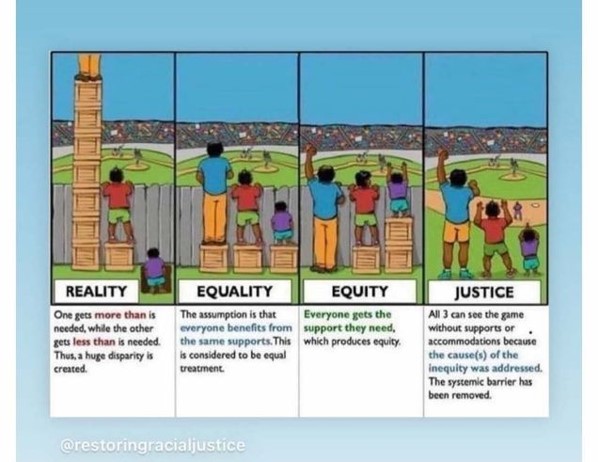
The above image by “@restoringracialjustice” explains the difference between reality, equality, equity and justice.
In communities around the world, these are trying times affected by local, national and global crises. Violence, poverty, the spread of disease across borders and environmental disasters are all part of what undermines the well-being of a global society. Addressing these problems will require new thinking and a deep examination of how equality, equity and justice are employed. All three conditions are necessary in order for the world to flourish and the unity of humanity realized.
As part of the way forward members of individual communities and nations need to take a thoughtful look at how to implement a social environment that fosters inclusion, understanding and mutual respect. This process begins with individuals examining their own beliefs and actions, identifying the assumptions and biases that create division. Reflection must be continuous, for prejudice and discrimination remain among the greatest obstacles to unity and the well-being of society. They are essential for the promotion of equality, equity and justice.
Equality exists when everyone is recognized, accepted, and valued as an important member of the community. The promotion of humanity’s oneness, welcoming of all, and making sure that everyone is given opportunities to participate in a collective are essential foundations for a healthy society. It requires a common understanding that each person can contribute to humanity in meaningful ways. It also means embracing the fact that caring for the earth is the responsibility of everyone in equal proportion to save the planet.
However, ensuring equality alone does not equate to unity of thought and action or access to opportunities. An examination of how inclusive practices cultivate equity for everyone regardless of their varied needs is essential for social progress.
Creating ways towards equitable distribution of resources and service is vital so that there can be universal participation in society. Individuals need to earn or receive a living wage so that food, clothing, health care, education, safety, and housing are guaranteed. When equity is applied there is recognition that fairness does not always mean providing identical solutions. Barriers can be overcome with creative thinking. For example, putting in ramps and elevators provides access to buildings. Offering transportation, financial assistance, language support or access to specific technology can make it possible for more people to participate.
Thought must also be given to examining the varied abilities of individuals within a society. Some people are born leaders. Others need to support the systems in place. Still others will serve quietly behind the scenes. Contributions must be expected that match disparate capacities of individuals. All of this will build strength as a means of creating the foundations for human unity.
Even when equity is applied and significant barriers are addressed, it may not be enough to invite people to participate in decision-making and take advantage of available essential services and resources. For instance, bus transportation can be arranged to allow individuals to travel to services and resources, but it can be difficult and time consuming. Specific challenges may discourage some people from attempting to access services and resources that come easily to others.
Justice requires identifying and removing barriers. For example, if healthcare is a challenge, then expanding local medical services can overcome disparity that isolates individuals and families. Safe housing, nutritious food, education and security should be available locally so that they are attainable to everyone no matter where they live in the community or their economic circumstances.
In a just environment a process of meaningful consultation that invites collaboration from the varied elements of a community or nation will require universal participation so that voices represent all sectors of society. A focus on quantitative data must be blended with qualitative storytelling in order to promote unity of thought and action. True leadership requires moving beyond personal and political power to champion equitable access and ensure essential services are guaranteed for all. Decisions must rely on moral and ethical values that support everyone in the community. Acceptance of decisions that occur when everyone feels they have been heard works towards promoting a just society. Realization that initial decisions may not always be the right fit for a particular mix in the population means a flexible approach needs to be taken.
Justice necessitates creative thinking, compassion, and a commitment to full community participation. Laws and mandates alone cannot achieve this; a spiritual rejuvenation of systems is required to ensure that structural guidance is inherently humane and just. Lasting transformation requires values and principles that are anchored in the recognition of our shared humanity. Only through this collective understanding can communities and nations forge a future shaped by dignity, cooperation, and peace for all.
Building our communities so that equality, equity and justice are at the center of every advancement will take time. Equality and equity alone do not guarantee unity. It requires a deliberate, focused effort to cultivate equality, implement equity, and, above all, achieve true justice.