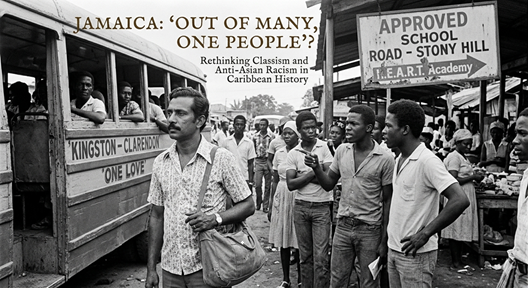
There were moments in my youth and in my early adult life when I heard it said that the problem in Jamaica was never about racism but one that was, more so, about classism. But having witnessed a few things over the years – even to the present – I am not so sure that classism has always trumped or upstaged the reality of racism and, to be more precise, especially racism of the anti-Asian kind. A few months ago, for example, a friend of mine, whose husband is of Chinese descent, shared with me the problems that he has been experiencing in that regard from his Afro-Jamaican counterparts at the place of his employment. In fact, although he is very much Jamaican – “born an grow” – he was told to go back to China, a place that is as unfamiliar to him as Africa is as unfamiliar to them.
As a boy growing up on the compound of an Approved School for boys, the child of a senior member of staff, I was exposed to different things, much to the consternation of my mother. An Approved School in Jamaica was a residential, rehabilitation-focused facility for “wayward” or troubled youth, often ordered by the courts, to provide education and vocational training. Historically, these were not prisons, but structured, secure environments aimed at rehabilitating boys (and girls) aged 12 to 18. That was the first time, as a pre-Common Entrance aged child, that I heard an anti-Indian racial epithet.
The boys in the school, who were much older than my younger brother and I, always found ways to amuse themselves during their off times. Sometimes they would, for example, find a remote bushy area on the very large compound, one which now houses, in part, the Stony Hill H.E.A.R.T. Academy, to do their own cooking. My brother, having a fascination for that sort of adventure, was sometimes right there with them. Such forays into the bush for that and for other reasons, at times, had us infested with ticks from the cows which were raised there and had us also experience skin irritation from a plant which was called Cow-itch. While playing with a kite with one of the boys, one day, I heard another boy shout out to him, “Coolie babu!” I did not know what those words meant. I was too young to understand such a concept, but the word hit me, nonetheless, at a visceral level and it stuck with me. The Indian fellow seemed to be unfazed by it and just kept on doing what he was doing.
As a teenager, after my family had relocated off the campus, I heard another anti-Indian racial epithet from a family member – “Bore-nose coolie” – uttered in a derisive tone. Again, I was urged by another never to bring any “Coolie gal” home. A former friend of mine stated that “the only good Indian was a dead Indian”, except for Mahatma Gandhi. I also recall a woman who I greatly respected, one who mentored me for a few years when I was in secondary school and in the ways of Christianity, casting grave spiritual aspersions on the entire race of Indians in Jamaica. Her message to me was quite clear that anyone of that ilk ought never to be trusted and should be avoided at all costs.
Was it classism or racism? Without discounting the reality of the first, the answer became very clear to me that racism was and still is very much a sociological reality in Jamaica, and not just towards Black people but also against individuals of Asian descent. Should anyone, whether in the rough and tumble of our streets or within the hallowed halls of academia argue that anti-Asian racism was not and is not a reality of our times then how does one account for such attitudes of scorn and of vitriol? And, how is it that one of our Caribbean brethren, a prolific writer of Indian descent, Mr. Samuel Selvon, in a 1979 public address to East Indians in the Caribbean Conference, speaking of the Caribbean experience as a whole, was able to say:
“Scholarly research has been focused overwhelmingly on the African dimension, and in the resulting Afro-centric view of Caribbean, the Indo-Caribbean is relegated to a footnote. (The same can be said of Amerindian studies; the annihilation of the Amerindians has been both physical and intellectual). Such academic marginalisation of Indo-Caribbeans, which leads to a flawed conception of the region, has been paralleled, and perhaps reinforced, by deliberate efforts to withhold economic and political power from them.”?
I believe that great strides have been made in the areas which were identified by Mr. Selvon, but I still get a deep sense of a marginalization of the recognition of the historical accomplishments made by Asian immigrants and by their progeny within the Caribbean.
Jamaica’s national motto is “Out of Many, One People”. It was adopted in 1962 upon the nation’s independence. It signifies that although the population is derived from diverse ethnic and racial backgrounds—including African, European, East Indian, Chinese, and Middle Eastern roots— that together they now form a single, unified nation. But, does our national motto capture the reality of the situation today or is it mainly aspirational? Without a doubt one can point to Indian and Chinese individuals who have distinguished themselves in business, in politics, in the various professions, in the performing arts, and in sports, but do the accomplishments of such sons and daughters of the soil gainsay the reality of anti-Asian racism in Jamaica? We have a plethora of history books which outline the experiences of the African Diaspora, but there appears to be a sparse amount which recount the experiences of our Indian and Chinese brethren. Why is that the case? When I studied West Indian History in secondary school the subject of Indian and Chinese indenture and immigration were, indeed, a footnote in our history. Was that due to systemic racism or as a result of some other factors? Was it because they are a statistical minority? Currently, people of Indian descent make up about 1.3% to 3.4% of the Jamaican population, and people of Chinese descent make up approximately 1.2%. Do such sparse figures justify their exclusion?
Having lived in the United States for decades as a Black immigrant I have experienced a few things in respect to anti-Black racism and xenophobia, especially in recent times. Part and parcel of that experience has been as a witness to the rank marginalization of the historical records pertaining to Afro-Americans, necessitating the need for Black History Month which originated in 1926. As I think of the peripheral treatment of Afro-Americans it is difficult to ignore similar treatment of people of Asian descent in Jamaica and in the wider Caribbean. No one doubts the horrors of African slavery, but little is known of the horrors of Asian Indenture – especially against East Indians. Another Caribbean writer of East Indian descent, Mr. Brinsley Samaroo, in an essay titled, Two Abolitions: African Slavery and East Indian Indentureship, quoted Viceroy Lord Hardinge as stating:
“Indentured labour really stinks in my nostrils as a form of slavery that we ought really to be ashamed of; there is no doubt that in a very large number of cases, there is a good deal of suffering entailed by it. Of course in Fiji the number of suicides is the most striking evidence of the viciousness of the system and nothing can explain this away.”
The Chinese indentured laborers and immigrants had their own tales of woe to tell. But, the matter was far worse for the East Indians which involved false advertising and kidnapping while still in their motherland; death on the high seas; rape; inhospitable working conditions; low wages paid and wages being withheld; rioting; pass-laws similar to those in Apartheid South Africa; physical abuse – which included severe beatings; newspaper vilification; imprisonment; alcoholism; suicide; murder; hunger; poverty; vagrancy; prostitution; insufficient legal representation and protection; illiteracy; and anti-Hindu and Muslim religious sentiments.
The caste system which was carried over from India also exacerbated immigration conditions within Indian communities and heightened misunderstanding of their behavior towards Blacks which was often misinterpreted as racism other than due to the insular peculiarities of their religion and ethnic culture. And the overarching problem which engendered racial tension among East Indians and Blacks was white, imperialist, colonialism. The modus operandi was the same as that which was used to create Black house slaves and field slaves. Unbridled profit stoked the fires of social discontent, and it now helps to explain, to a great degree, the racial prejudice that was harbored against people of Indian and Chinese descent as much as that which Blacks experienced and still experience today in the African Diaspora.
When Indians were migrating from the motherland for the West Indies they knew that they were needed to do work. What they might not have been told was that they were needed on sugar plantations that were vacated by Blacks who were recently emancipated from slavery. They were not told that the white planters still entertained racist ideas towards people of color. They were not told that they were being used, in part, to depress the wages of free Black workers. And they were not told that the cost of their immigration was not just at the expense of the planters, but that it was also being underwritten by the taxes that were collected from the same Black workers by the Colonial governments. Capitalism cut off the Indian’s legs below the knees, just as it had done to those of the Black man, and then called him “Shortie”. It is no wonder, at the time, that Blacks in the Caribbean had lobbied hard, out of great resentment, for the ending of Indian Indenture.
And, so what do we do in order to address the issue of anti-Asian bigotry? Does it still exist or are my observations and, more so, those of Asian-Jamaicans well outside of the realm of reality? After all, we as a nation cannot address what does not exist and, hence, salve what is not seen as highly problematic and damaging. I believe, therefore, that an exposure to sound historical and civic educational material on the subject would be a good place to begin. Is such material available and used in our educational system? I have sought access to books like Home Away from Home: 150 Years of Indian Presence in Jamaica, 1845–1995, by Laxmi Mansingh and Ajai Mansingh, which provides a detailed history of the Indian community, including challenges faced; and Transients to Settlers: The Experience of Indians in Jamaica, 1845-1918, by Verene Shepherd, which examines the transition from indentured laborers to permanent residents, addressing social marginalization; and Race and Ethnic Identity in Rural Jamaica: The East Indian Case, by Allen S. Ehrlich, which is an academic article focusing on how Indo-Jamaicans in rural areas were perceived and treated. I have found that such publications are either quite hard to find or prohibitively expensive.
I have had the privilege of reading the work titled: Indentured Labor, Caribbean Sugar: Chinese and Indian Migrants to the British West Indies, 1838-1918 , by Dr. Walton Look Lai; and I am currently in the process of going through the book: India In The Caribbean, edited by Mr. David Dabydeen and Mr. Brinsley Samaroo, which was published in 2006. These works have proven to be eye openers and can serve as vital resources for a deep understanding of this delicate and tragic subject. If we are serious about the vision behind our national motto then we owe it to ourselves to gain as much knowledge on this subject as possible, and pass it on to others, especially to the next generation.