Grasping the truth is more complex than most people will acknowledge. What we accept as truth is shaped not only by what we can observe and measure, but also by the values and assumptions through which we interpret what we see and experience.
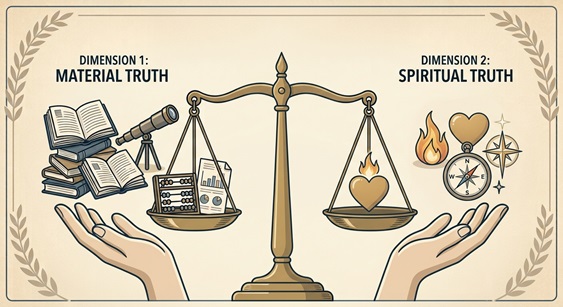
There are two dimensions of truth I would like to consider: spiritual truth and material truth.
Spiritual truth is one that guides us morally and ethically. It examines intangible features that guide us through life. In a spiritual sense there is only one truth. That truth is uncovered in the writings of prophets and sages. At the core of this truth is the fact that we are members of one human family. Treating each other with dignity and respect are core values that should be in place for every life decision. Understanding that our purpose on earth is to enhance a global humanity and environment is important. All living things are valued. There is universal agreement over the nature of truth.
On the other hand, material truth relies on tangible components: observable events and objects, and scientific discoveries that are verified by empirical evidence. Information impacted by the perspective, culture and background of individuals is reflected in the presentation of facts that are accepted as truth. Different aspects of truth are likely to be uncovered. There is little that can assure unity of thought or action.
Within a material perspective of truth, power and prestige are often interpreted with great importance in decision-making. Therefore, diversity of thought and possibility may be limited by the voices that are heard and accepted. When the strongest or most popular presentation is relied upon to choose which action or outcome is acceptable, the result is that this creates opportunities for decision-makers to impose biased policies on others. This opens the door for disputes over whose idea is the best choice.
Looking at how we make decisions is necessary. A process that includes several steps and is both spiritually and materially acceptable, is considered for effective decision-making. It involves study with research, group consultation, action, and reflection. Researching factors that will impact a decision prior to consultation will provide a basis for discussion, but they must be impartially accepted.
Consultation itself needs to include diverse voices and perspectives. All interested parties need to be at the table. Actions must be flexible in case they need reworking for improvement and for the betterment of the community. Most importantly, actions are followed by reflection that examines the immediate impact, but also how both the targeted population and anyone involved in enacting a decision were transformed. This includes not only looking at how actions affected the community and satisfied the needs that were identified through consultation, but it also means everyone considers how they benefited or if there were any drawbacks that were a result of the action.
Learning from research, study, consultation, and action must be part of the outcome of every decision. This has tremendous implications for members of legislative bodies and service organizations who need to understand that reflection is an essential tool for their success. Learning from mistakes and success is vital to good decision-making.
The blending of spiritual and material truths provides the essence of good decision-making. It advances the exclusion of self or group interests in favour of values that promote the oneness of the human family and are world-embracing. This is crucial for success in a global society as well as in families, organizations, and communities.
All members of a decision-making body must be seen as partners with equal status. Members of the consulting group listen with an open mind to the research and ideas that are brought forward. Prejudice and biases need to be overcome with universal acceptance of a variety of perspectives, culture and experience. Releasing personal goals and interests are essential components for effective consultation. Understanding that egotism, hubris and imperiousness can overpower conclusions is important. When a few people profit financially, politically or personally, valuation of our common humanity is damaged.
Actions emerge from unbiased conversation that allows everyone to participate freely. Once a project is complete it is important to step back and reflect on what occurred. This includes not only looking at how actions affected the community and satisfied the needs that were identified through consultation, but it also means everyone considers how they benefited or were harmed as a result.
The goal of decision-making lies in the concept of fairness and justice for all. This is essential for success in a global society as well as in families, organizations and communities.
As the world moves forward to solve complex and challenging problems, it is important that both spiritual and material truths intercept. Making fair decisions that include both the material and spiritual truths will advance unity and justice.