
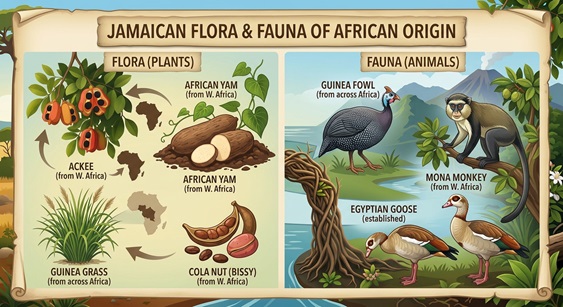
Flora and Fauna from Africa were first brought to Jamaica by the Spaniard Diego, son of Christopher Columbus, through enslavement of Africans and continued by the British from the 1650s until the end of Trans-Atlantic Slavery in 1807.
Enslaved Africans came from modern day Ghana, Nigeria, Toga, Benin and the Congo Region. The Ethnic groups were Akan, Ashanti, Igbo and Yoruba.
The main Flora: yams, ackee, cerasee, callaloo, plantains, grains such as cow peas and gungo peas, kola nut (bissy) for tea and tonic, guinea grass for cattle, okra and coffee.
The main Fauna: The fish tilapia, guinea fowl brought as domestic bird, chigger a flea.
Although yams were brought by the Tanios (Indigenous people of Jamaica from South America), yams were commonly consumed in Sub-Saharan Africa around 5000-4000 BC. Yams were used as supply for ships because of the ability for long sea voyages and a source of Vitamin C, important for sailors to combat scurvy. However, yams were brought to the New World on Portuguese slave ships. It is estimated that there are over 600 varieties of yams but only a small number is edible. Few African names have been retained and the most popular is Afu or Yellow yam.
The first oral contraceptive pills were developed from a species of yams from which both the female hormone progestorme and the male hormone testosterone can be synthesized. The first pills were produced in Mexico. Yams are still used in India and China for the process. Enslaved Africans were forced to feed themselves and were allotted plots to cultivate for food as well as for Sunday markets.
Cerasee: This is used for tea and medicine. It has a bitter taste and is used for colds, fevers, acne, and as a tonic. It is a climbing vine of the cucumber and melon family. Research is continually undertaken for its medicinal value especially as a cure for stomach ache. There is a popular folk song about Helena and the search for cerasee
- Callaloo: A vegetable used for soup.
- Plantains: A member of the banana family
Grains and beans: Cow peas, gungo peas
Kola nut: (bissy) used for tea and as atonic.
Ackee: The records state that this came to Jamaica from West Africa in 1778 on a slave ship. Ackee with salted cod fish is now the national dish of Jamaica.
Guinea Grass: This was brought from West Africa as bird feed and used in pastures for livestock.
Coffee: Introduced to Jamaica 1728 originally from Ethiopia by the Governor Sir Nicholas Lawes and first planted at Temple Hall in the parish of St. Andrew. The industry got a boost when planters fled from Haiti, then St. Dominingue, to Jamaica during the revolution there.
Okara : This is a vegetable used mainly in soups.
The fauna
By the time the English arrived in Jamaica the Spaniards had introduced a substantial number of fauna including animals and birds.
Tilapia: This fish was introduced from Africa for pond farming
Guinea fowl: Brought from Africa for domesticated purpose.
Chigger: This is a Tropical disease appearing in Africa about 1872 according to bio historian Alfred W. Crosby Jr. Chigger is a skin burrowing flea which penetrates the skin between the toes or under the toe nails where the eggs are laid. The site, because of itching, can let in bacteria and lead to gangrene. The wearing of shoes, especially since after Emancipation, has led to this disease being almost extinct.
Which of the flora and fauna from Africa have the most international impact on Jamaica ?
While none of the Fauna has gained international recognition two items from the Flora have made significant impact at the international level.
ACKEE: This is a fruit which is used as a vegetable and if not handled properly can cause poisoning. Therefore the fruit should be eaten only when opened. Ackee with saltfish is Jamaica’s national dish. The fruit is sautéed with salted cod fish and ingredients of onion, scotch bonnet pepper, tomato and spices. The scientific name of the fruit is Bliah Sapedia in honour of William Bligh who took the fruit from Jamaica to the Royal Botanical Gardens in Kew England 1793.
In West Africa ackee is not eaten as food but as medicine or ingredient for soap making. In other parts of Africa — such as Katiola, Sinematiali and Khorogho — it is consumed as food from dried paste.
According to the Guardian, Jamaican sprinter Usain Bolt often has ackee and saltfish for breakfast. Harry Belafonte‘s 1956 hit song Jamaica Farewell declares, “Ackee rice salt fish are nice”.
COFFEE: Jamaica’s Blue Mountain coffee is world famous. It grows in the misty Blue Mountain 1,800 feet above sea level and is known for its taste, mild flavour, and lack of bitterness. Coffee is a sought after gift from Jamaica.