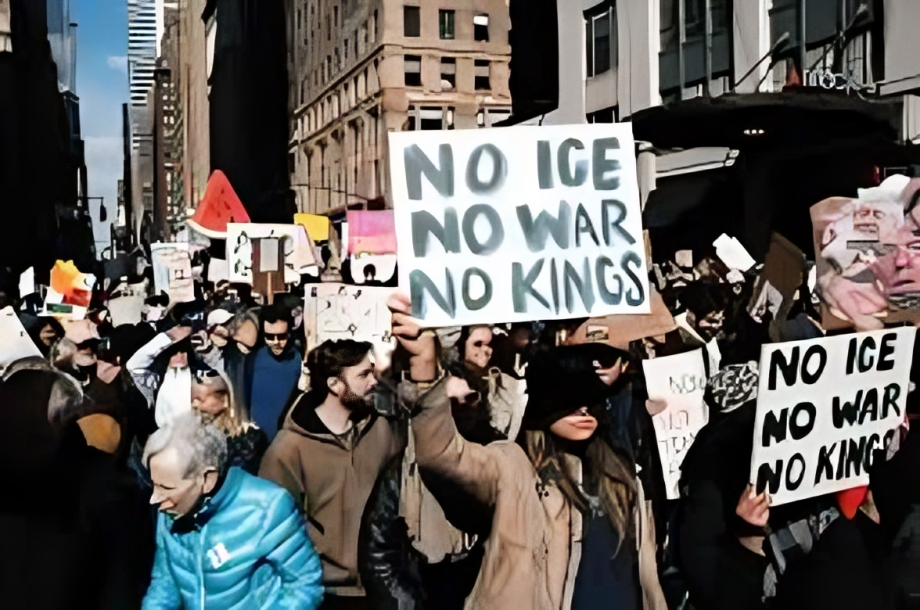
Millions of people around the world took to the streets on Saturday, March 28, to express their support for peace and unity. The movement, known as “No Kings Day,” brought together voices from across continents.
Marches and rallies were held throughout North America, Europe, Latin America, and Australia. In the United States alone, more than 3,000 gatherings took place, with participation in every state—from large cities to small towns. People came together to speak out against violence, including conflicts in Iran and the Middle East, racism, immigration policies, and actions by governments perceived to oppose democratic values. By sheer numbers, their voices were powerful and unmistakable.
This was a remarkable, even herculean effort—one that has occurred three times since the beginning of 2025 and has grown stronger with each occurrence. It deserves recognition for its courage and its ability to bring people together, not only for a day but, one hopes, for the future. Participants united in a shared desire to challenge what they see as harmful policies and conditions.
However, such efforts alone cannot resolve the deeper challenges facing our global society.
The world has yet to fully awaken to the reality that lasting solutions will not be found solely in government policies, legislation, protests, or social media. The root of our current crises lies in a weakening spiritual foundation—one that is essential to temper materialism, greed, and the pursuit of power. There is no single action that can remedy our present condition, and the obstacles before us are many.
Insights from the Universal House of Justice (November 2022) offer a perspective worthy of reflection:
“…consider what a grave obstacle to the unity of the human family is presented by failure to understand the truth of its essential oneness! Any sense of unity that comes from the shared identity of a group becomes the basis of contest with those perceived as ‘other’. Humanity is split into competing interest groups, many locked in a fight for dominance. Conceptions of conflicting interests inhibit the collective capacity to transform social conditions and address challenges for the benefit of all. In the religious, social, political, and economic spheres of life, conflict driven by narrow self-interest is deemed natural and inevitable. Rivalry between groups harms all, obstructs justice, and suppresses the potentialities of individuals and groups, whose contributions are necessary for the betterment of society.”
This raises an important question: might gatherings such as “No Kings Day,” despite their noble intentions, risk reflecting the very dynamics described here? When groups organize around shared grievances or perspectives, they may unintentionally reinforce divisions—defining themselves in contrast to others.
Consider the differing views surrounding major global issues. Some see war as unjust and destabilizing, pointing to its human and economic costs. Others view it as a necessary response to oppression. Some believe immigration policies have become too restrictive; others feel they are insufficient to ensure safety and stability. These differences are real and deeply held.
In gatherings of like-minded individuals, such perspectives can become more firmly entrenched. Positions may harden, opposition may intensify, and the space for genuine unity can narrow. In this way, efforts intended to promote justice and peace can, inadvertently, contribute to further polarization.
The answer lies in reflecting on the messages brought by moral guidance around the world, that equity and justice are essential for universal peace. With equity and justice, we understand that even though we all are the same, we also have a variety of needs.
A story from Aesop’s Fables may help illuminate the path forward:
“Once, a Fox and a Stork were friends, though the Fox loved to play tricks. One day, the Fox invited the Stork to dinner and, intending to be selfish, served thin soup in a shallow, flat dish.
The Fox lapped up his soup quickly. However, the Stork, with her long, thin beak, could not eat any of it. She went home hungry.
A few days later, the Stork invited the Fox for dinner. She served delicious fish stew in a tall, narrow jar with a long neck. The Stork easily ate, but the Fox could only lick the outside of the jar.
“This is not fair!” grumbled the Fox.
The Stork replied, “Equality would mean we both eat from the same shallow dish. But that was not just, as it only suited you. Justice is giving each person the right tool to enjoy the feast.”
This simple story points to a profound truth. It is not enough to recognize that all people share the same basic needs. We must also understand that individuals and communities have different circumstances and capacities, which require thoughtful and compassionate response.
What affects one part of the world inevitably touches another. In an interconnected global society, the well-being of one people is bound to the well-being of all. Without a commitment to justice that considers both unity and diversity, efforts to build peace will fall short.