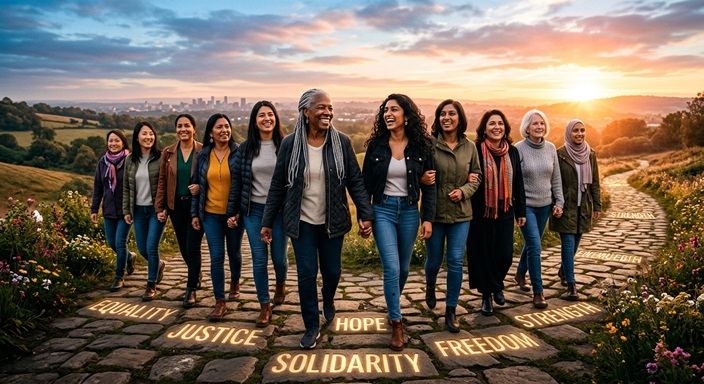
A song, “This is Our Day” by the Lyrical Lanterns was produced for International Women’s Day, March 8, 2026. It highlights the challenges that women face, but offers hope and encouragement, “Every scar became a story, every ‘no’ became a door. We were told to keep it quiet, but we don’t do that anymore.”
The history of women’s rights in the United States reflects a long and often difficult struggle for equality and justice. In 1848, the Seneca Falls Convention, organized by Elizabeth Cady Stanton, Lucretia Mott, and other reformers, produced the Declaration of Sentiments, calling for social, civil, and religious rights, including the right to vote. It took another 72 years for the Nineteenth Amendment to be ratified in 1920, prohibiting the denial of voting rights based on sex.
Progress continued with the Equal Pay Act of 1963, which sought to address wage discrimination based on sex. Yet legislation alone has not eliminated inequities in the workplace. Differences in job classifications, opportunities for advancement, and compensation practices can continue to undermine the principle of equal pay for equal work. For those of us who worked through the 1960s, 1970s, 1980s, and into the 1990s, the pursuit of fairness was often an uphill battle. The experiences of those generations remind us that progress requires not only laws, but also the willingness to examine and change established practices. It takes motivation propelled by a spiritually enlightened heart and a great deal of courage.
The international movement for women’s rights has also made significant strides. When the United Nations was established in 1945, Eleanor Roosevelt became a leading advocate for human rights, “The fundamental purpose of feminism is that women should have equal opportunity and equal rights with every other citizen.” She chaired the UN Commission on Human Rights, which helped develop the Universal Declaration of Human Rights, adopted in 1948. The declaration affirmed that human rights belong to everyone, without distinction based on sex. Later, the Fourth World Conference on Women, held in Beijing in 1995, advanced a global agenda for women’s empowerment and gender equality.
Despite these milestones, women in many parts of the world continue to face substantial economic burdens, discrimination, violence, and restrictions on their rights. Too often their contributions to families, communities, and society go unrecognized, while legal, religious, and social structures limit their opportunities to participate as equal partners.
A United Nations report released on March 4, 2026, brought this continuing injustice into sharp focus. According to UN Women, “No country in the world has achieved full legal equality for women and girls”. This finding reminds us that the pursuit of justice is not a completed chapter in history; it remains a responsibility shared by the international community. [Source: UN Women, March 4, 2026.]
Nevertheless, there are encouraging signs of progress. International efforts have increasingly focused on protecting women from violence and strengthening their legal rights. The UN has reported that 87 per cent of countries have enacted domestic violence legislation and that more than 40 countries have strengthened constitutional protections for women and girls over the past decade. These developments demonstrate that concerted action can make a difference, even as much work remains.
The 70th Session of the United Nations Commission on the Status of Women in 2026 further underscored the continued urgency of this work. As the UN’s principal intergovernmental body dedicated to advancing gender equality and women’s empowerment, the Commission provides an important forum for countries to address barriers to justice and promote women’s rights. UN Women Executive Director Sima Bahous opened the session with the following remark: “It is our task, our responsibility, to make real the commitments and promises we have made to all women and girls”. She emphasized the need to stand up for rights, justice, and action so that every woman and girl can live safely, speak freely, and live equally.
The song that inspired this article offers a message of courage, persistence, and hope. But celebrating women must mean more than recognising their achievements on one designated day. It means creating societies in which women are safe, their voices are heard, their contributions are valued, and their opportunities are not limited by gender.
Equality is an essential principle, while equity calls us to recognise and address the barriers that prevent people from enjoying that equality in practice. Both are necessary if we are to build communities founded on justice, mutual respect, and shared responsibility.
The progress of women is not solely a women’s issue. It is a human issue, affecting the well-being of families, the strength of communities, and the future of humanity. Each of us has a role to play in advancing a world where women and girls can develop their capacities, contribute their talents, and participate fully in shaping the future. The song concludes, “We rise strong and unafraid. We won’t look away.”