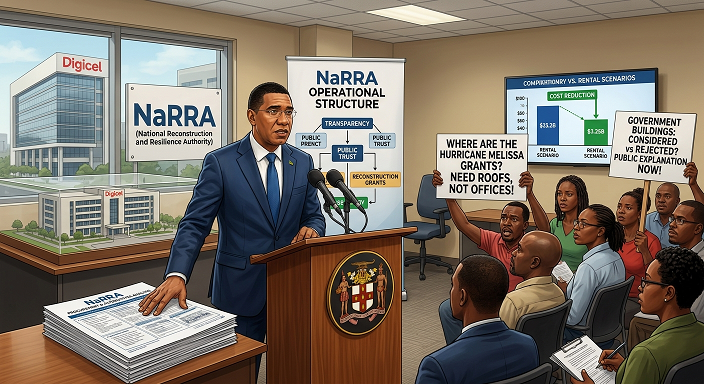
Prime Minister Dr Andrew Holness deserves credit for responding
swiftly to the public outcry over the Government’s decision to establish
the National Reconstruction and Resilience Authority (NaRRA) in two
floors of the Digicel building at an annual rental cost of roughly $115
million.
His decision to scale down the initial arrangement and start NaRRA on
one floor demonstrates that the Government is listening. More
importantly, it acknowledges that, at a time when thousands of
Jamaicans are still struggling to recover from Hurricane Melissa, optics
matter almost as much as the expenditure itself.
But while I commend the prime minister for reacting to the outrage, I
must also ask why the Government allowed itself to get into this
position in the first place.
It should not have taken a public backlash for the Administration to
recognise that spending approximately $115 million a year to house a
new Government agency would raise eyebrows, particularly while
hurricane victims are still waiting for roof grants, shelter and other
assistance a year after the Category 5 storm destroyed homes, business
and infrastructure in Jamaica’s south- and north-western parishes.
The Government says the Digicel building was selected because NaRRA
requires a disaster-resilient headquarters capable of remaining
operational after a hurricane or earthquake. That is a reasonable
consideration for an authority whose job is to coordinate national
reconstruction and resilience.
But it does not answer a fundamental question: Did the Government
thoroughly examine the availability of suitable State-owned buildings
before entering into a five-year rental agreement with the owners of
the Digicel building?
The Opposition has claimed that the Government has hundreds of
thousands of square feet of office space across the country, some of
which is underutilised. That assertion cannot simply be dismissed. The
Government owes taxpayers a clear explanation of what buildings were
considered, why they were rejected, what criteria were applied and
whether any existing State property could have been retrofitted to
meet NaRRA’s operational requirements at substantially less cost.
This is particularly important because the prime minister himself has
acknowledged that further negotiations over the Digicel lease could
have been possible.
The Government must also explain why should the size of NaRRA’s
physical headquarters determine the pace at which its projects are
rolled out? Surely an authority established to oversee the
reconstruction of hurricane-ravaged communities should be driven by
the urgency of the work, not the amount of office space it occupies.
I can understand, however, why the Government may be moving
cautiously. The scale of the devastation caused by Melissa demands
that reconstruction be done properly. NaRRA is being created to
coordinate an extraordinarily complex national undertaking involving
billions of dollars, multiple agencies, international development
partners and communities whose lives and livelihoods have been
shattered.
There is, therefore, some justification for taking the time to put the
right systems, structures, personnel and safeguards in place rather than
rushing into an arrangement that later proves defective. The apparent
slowness in getting NaRRA fully operational may, in part, reflect an
effort to ensure that the rebuilding process is properly organised. That
is understandable. But patience has limits, particularly among people
still living under tarpaulins or waiting for assistance.
And this is where the Government faces its biggest challenge: trust.
NaRRA will have enormous responsibilities and, presumably, access to
substantial public and international resources. If Jamaicans believe that
the authority is being established extravagantly or without sufficient
regard for value for money, every subsequent decision it makes will be
viewed through that lens. That would be dangerous.
Without public trust, NaRRA will remain vulnerable to being used as a
political football by the Opposition and by so-called civil society groups,
some of whom may be more interested in attacking the Government
than helping to ensure that reconstruction succeeds.
The Government therefore needs to understand that transparency is
not an inconvenience attached to reconstruction. It is part of
reconstruction.
Mr Holness has taken the right first step by responding to public
concern and reducing the initial footprint of NaRRA. Now the
Government should go further: explain how the Digicel building was
selected, account for the alternatives considered, demonstrate that
taxpayers are receiving value for money and show Jamaicans exactly
how NaRRA will deliver results.
The country needs NaRRA to succeed. But the Government must
recognise that success will depend not only on rebuilding roads,
bridges, homes and communities, but also on rebuilding public
confidence in the way the job is being done.