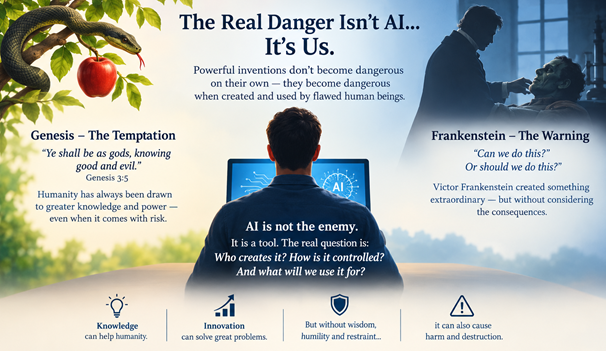
“Now the serpent was more subtle than any beast of the field which the LORD God had made. And he said unto the woman, Yea, hath God said, Ye shall not eat of every tree of the garden? And the woman said unto the serpent, We may eat of the fruit of the trees of the garden: but of the fruit of the tree which is in the midst of the garden, God hath said, Ye shall not eat of it, neither shall ye touch it, lest ye die.
And the serpent said unto the woman, Ye shall not surely die: for God doth know that in the day ye eat thereof, then your eyes shall be opened, and ye shall be as gods, knowing good and evil. And when the woman saw that the tree was good for food, and that it was pleasant to the eyes, and a tree to be desired to make one wise, she took of the fruit thereof, and did eat, and gave also unto her husband with her; and he did eat.”
The Book of Genesis
There is great alarm and much talk about the dangers posed by artificial intelligence (AI) to our world of tomorrow. From what is being discussed in the news about the prospect for unimagined human advancement through the rapid and the exponential development of AI, such glittering hope is gravely overshadowed by ominous clouds of human annihilation. And against such unsettling trends posed by AI, all that mankind has to do to counter that threat is, simply, to pull the plug out of the electrical socket. AI has not yet reached the autonomy of the animals in the wild, nor of the pests with which we contend, daily, armed with pesticides. So, all that we have to do is to flip the power switch.
But given our history as a race it is more than reasonable to assume that we will never, ever do so. It is in our DNA to flirt with danger. It is our natural propensity to see how close we can get to the edge of the proverbial cliff without tumbling over into destruction. The battle being waged at the moment is not against AI becoming psychotically and nefariously self-aware, but against our own hubris. As was the case with Adam and Eve in the Garden of Eden, on the infamous and fateful day of the fall, we folks have not learned. As it was in the beginning, so shall it be in the end with AI.
Given the introduction to this opinion piece I could well understand anyone who might mistake me for a cynic — overly religious or otherwise — or as a person who has a morbid and an irrational fear of scientific knowledge and of technological advancements. But, I want to assure my readers that I am none of those. Old dinosaur that I am, I have to use a computer in job-related activities everyday.
For as long as I have been using computers there is still so much that I do not know about them. And, with my modest dietary intake from the tech-world tree of life with its indisputable fine fruit from the branches of “hardware”, “software”, “IP addresses”, “URLs” and the like, I am, conversely, and, routinely, taught and tested, by my agency’s IT department, on how to avoid eating such bitter fruit from “spyware”, “ransomeware”, “viruses” and “phishing”.
For a long time before the threat of rogue artificial intelligence humans created such malware to dim the promises of progress, prosperity and peace that computers, at their advent, were portended to bring to mankind. Mankind has ever been like the fabled Dr. Frankenstein, with the potential for creating a tool for good or a monster for evil, through their latest and greatest invention called, AI.
Perhaps it is quite in keeping to recall the story of Frankenstein at this juncture. Dr. Victor Frankenstein was the brilliant, obsessive young scientist from Mary Shelley’s 1818 Gothic horror novel Frankenstein; or, The Modern Prometheus, who created a living creature from reanimated body parts only to unleash a tragic chain of destruction. Fascinated by natural philosophy, chemistry, and the secret of life, Victor spent years at the university unearthing the mysteries of generation and life. He stole bones from charnel houses and bodies from fresh graves, and secretly assembled a giant humanoid figure in his attic laboratory.
When the yellow-eyed, eight-foot-tall creature finally gasped to breathe, Victor was instantly filled with horror and disgust, abandoned his living canvas and fled the room. The creature was gentle at first, learning language and empathy by secretly observing a poor family in a cottage. But humans ended up rejecting and attacking him on sight because of his grotesque appearance.
Embittered by endless cruelty and parental neglect, the intelligent creature then demanded that Victor build him a female companion. Terrified that a race of monsters would spawn, Victor destroyed the second creature. In a fury, the monster vowed revenge. The creature systematically murdered Victor’s closest loved ones, including his best friend, Henry Clerval, and his bride Elizabeth Lavenza.
Consumed by guilt and a desire for vengeance, Victor chased the monster across Europe and all the way into the freezing Arctic wastes. Victor then died of exhaustion and illness aboard a captain’s exploration ship trapped in the ice. And as for Victor’s monstrous creation, with remorse and grief, it vanished into the darkness and ended its own life. Will this be our end with Artificial Intelligence — thinking only if we can create something and not whether we really should. Victor Frankenstein created the monster out of a deep scientific ambition to conquer death, to unlock the secrets of life, and to achieve immense glory.
Many groundbreaking discoveries which were designed to help humanity ended up causing harm or being weaponized. Dynamite, for example, was invented by Alfred Nobel in 1867 to make construction, mining, and tunneling safer and more stable than raw nitroglycerin. It quickly became a devastating weapon in warfare, leading Nobel to establish the Nobel Prizes out of regret for its destructive legacy. Was he, somehow, a tragic figure like Victor Frankenstein?
Plastic was invented by Leo Baekeland in 1907 (Bakelite) as a cheap, durable substitute for natural materials like ivory and shellac, aiming to conserve wildlife and natural resources. And, what have we seen of that invention today? Mass-produced synthetic plastics have resulted in a global pollution crisis, clogging oceans and harming ecosystems worldwide. Then there is social media. Early platforms were created to connect people globally, to foster community, and to share information freely across distances.
They have, however, been manipulated in order to spread severe misinformation, to target users with addictive loops, to facilitate cyberbullying, to erode mental health and to, negatively, sway the outcomes of political elections. All good inventions until their glimmer of hope was tarnished by the cankered, baser part of man.
And so, I am not afraid of artificial intelligence. I try, for example, to put it to good use, often, in the gathering, the organization, the clarification and the dissemination of knowledge. I am, however, conscious, all the while, that it is a product of man, who is flawed, and not a product of God. Like so many inventions which were developed on the basis that we, simply, could create them, because “the sky is the limit”, we have, in turn, come to see and to hear of so many people who were, at first, their beneficiaries, now exhibiting deep regret because we as a race lacked the wisdom, the humility and the self-restraint to stay “on the straight and narrow”.
I am not afraid of artificial intelligence, per se, but, I am, nonetheless, far more concerned about its creators and of the direction that they would like to provide for its development.