“They told us look up to the heaven, let your worries fade,
While they were down in the dirt taking everything we made.
They said turn the other cheek, wait for the promised land,
We closed our eyes to pray and they stole the sand.
No, the ancestors didn’t fail — they were ambushed by grace.
They brought a war in a smile to a peaceful place.
Before we could even say amen,
The chains were already on the wrists of men.” Blueprint – UyiosaEL
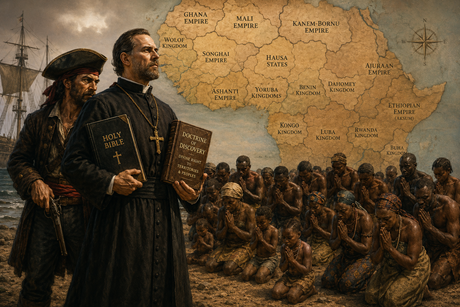
When the modern world speaks about slavery, colonization and conquest, it often discusses ships, chains, plantations and empire. Less discussed — and perhaps more uncomfortable — is the theological architecture that helped justify these atrocities for centuries. At the center of that architecture stood the Catholic Church’s Doctrine of Discovery, a collection of 15th-century papal decrees that gave Christian empires divine authorization to conquer lands occupied by non-Christians, seize territory, suppress indigenous religions and reduce entire populations to servitude.
The Dum Diversas (1452), was issued by Pope Nicholas V and it gave Portugal the right to invade, conquer, and subdue all “Saracens, pagans and other enemies of Christ” and reduce them to perpetual slavery. The Romanus Pontifex (1455), also issued by Pope Nicholas V, granted Portugal exclusive rights to claim territories in West Africa and declared that non-Christians lands should be subjugated for Christ sake; while the Inter Caetera (1493), issued by Pope Alexander VI, decreed that Spain and Portugal would divide the “ New World” between them and that land not inhabited by Christians was available to be “discovered, claimed and exploited”. The racist Doctrine was only formally repudiated in March 2023, 571 years after it was first issued.
For Africa, the Americas and indigenous societies across the world, the Doctrine of Discovery was not merely theology. It became policy. It became International Law- Johnson v Mcintosh and Canadian property precedent (1823- U.S. Supreme Court). It transformed Christianity from a spiritual faith into a geopolitical weapon. European crowns marched under the cross. Missionaries followed soldiers. Conversion arrived alongside conquest.
The result was catastrophic.
Millions were enslaved. Civilizations were dismantled. Indigenous spiritual systems were demonized. Sacred lands were seized; languages disappeared. Entire generations were taught that their ancestors were uncivilized, heathen or spiritually inferior. Meanwhile, European institutions — including the Church itself — accumulated extraordinary wealth and influence during the expansion of empire.
Today, when Pope Leo XIV issue apologies for the Church’s role in slavery, colonization and abuses against indigenous peoples, an unavoidable question emerges: what does apology mean after 574 years of profit?
Around the world, reparations have long been recognized as a necessary response to crimes against humanity. Holocaust survivors received compensation from Germany. Victims of Japanese internment in the United States received formal reparations. Families impacted by state abuses in numerous countries have received settlements, memorialization and official acknowledgements.
If financial compensation is considered appropriate for other historic atrocities, why is the conversation about reparative justice for slavery and colonial exploitation still treated as radical when Africa and the African diaspora raise it?
An apology without restitution risks becoming symbolism without sacrifice.
The Vatican, one of the wealthiest religious institutions on earth, cannot speak only of sorrow while remaining silent on the economic legacy of empire. How much wealth flowed through Church-backed colonial systems? What role did Church institutions play in legitimizing conquest? How many missions directly benefited from enslaved labor, stolen land or forced conversion?
The world deserves transparency.
Perhaps the time has come for the Vatican to go further — not merely with carefully worded apologies, but by opening its archives and vaults to full scholarly examination. The histories hidden within those walls may reveal uncomfortable truths about the suppression of indigenous spiritual systems across Africa and the Americas.
Across the African continent, ancestral traditions were condemned as paganism. In the Caribbean and Latin America, indigenous and African spiritual practices were outlawed, driven underground or violently suppressed. Sacred objects were destroyed. Priests and spiritual leaders were persecuted. Oral histories vanished under the pressure of colonial education systems.
In parts of Central and South America, entire indigenous populations were massacred in the name of Christian expansion. In Africa, colonial administrators and missionaries often worked hand in hand to restructure societies according to European religious and cultural norms.
The question must be asked honestly: why are these histories not central to school curricula around the world?
Why do so many students graduate knowing the dates of European wars yet remain largely ignorant about the theological justifications used for slavery, conquest and cultural erasure?
Why are generations taught about missionary expansion without equally learning about forced conversion, destroyed traditions and resistance movements?
And why, in many formerly colonized countries, do the most prestigious educational institutions remain tied to the very Church structures that accompanied empire?
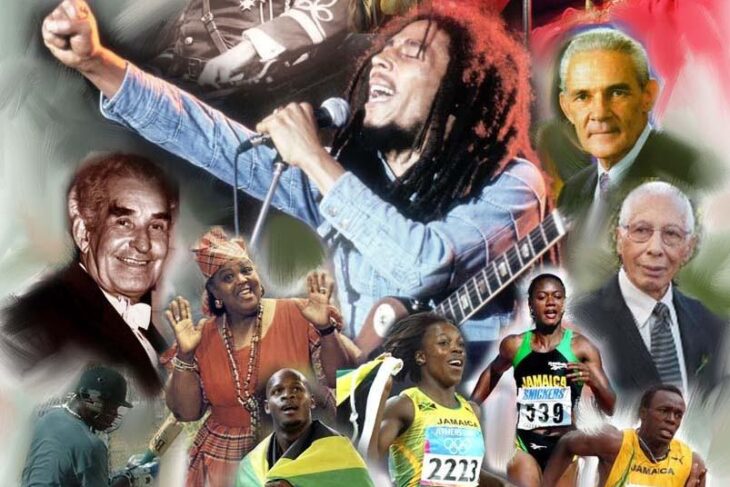
Marley captured this tension powerfully in Babylon System, “Building church and university, deceiving the people continually, graduating thieves and murderers.”
For many Africans and descendants of the enslaved, those lyrics resonate not because education itself is evil, but because colonial education often functioned as historical conditioning. Entire populations were taught to admire the systems that conquered them while distancing themselves from their own spiritual and cultural inheritance.
This is not an attack on faith. Millions of Africans are sincere Christians whose spirituality provides meaning, discipline and community. But faith must not be immune from historical examination.
The Bible itself repeatedly describes God as all-knowing and omnipotent.
“Known unto God are all his works from the beginning of the world.” — Acts 15:18.
“For his eyes are upon the ways of man, and he seeth all his goings.” — Job 34:21.
If God sees all and knows all, then believers are left wrestling with profound moral questions about how divine authority became attached to systems that brutalized millions.
Philosophers have long wrestled with this dilemma through the Epicurean Paradox: if God is willing to prevent evil but not able, then he is not omnipotent; if able but not willing, then why permit suffering?
For generations, enslaved Africans prayed to the same God invoked by enslavers. Colonized peoples knelt before the same cross carried by conquerors. That contradiction still echoes through history.
Some ask, with painful irony: was heaven silent, or were men simply speaking for God without accountability? Was God unaware that his name and image were being used to justify slavery, massacres and conquest? Or does the Epicurean critique expose a contradiction humanity has long feared to confront?
These are uncomfortable questions, but they are necessary ones.
The modern Church cannot merely ask the descendants of the oppressed to move on while retaining the institutional authority built during centuries of conquest. True repentance demands truth. Truth demands disclosure. Disclosure demands education.
And education demands courage.
Where, then, do Black Christians go from here?
For many, Christianity has become deeply woven into identity, family and culture. Others, however, are beginning to revisit African spiritual traditions that survived despite slavery and colonization. Across the continent and the diaspora, younger generations are studying indigenous cosmologies, ancestral practices and pre-colonial philosophies once dismissed as primitive, evil and witchcraft.
This renewed interest is not necessarily about rejecting spirituality. It is about reclaiming memory.
The Doctrine of Discovery described indigenous peoples as lesser civilizations requiring Christian domination. That worldview helped justify centuries of violence in the name of salvation. Now that even Church leaders acknowledge historical wrongdoing, many descendants of the colonized are re-examining what was lost — and what was deliberately erased.
Sizzla expressed a similar frustration in “No White God,” questioning whether the religion imposed during colonialism could truly liberate people from systems of oppression built alongside it. For some, the conclusion is increasingly unavoidable: a “white god” constructed through colonial imagery could never save Black people from white supremacy because that religious framework historically evolved beside the very structures of domination they now seek to escape.
Whether one agrees with that sentiment or not, the underlying issue cannot be dismissed: millions are confronting the psychological legacy of colonial Christianity and asking whether liberation requires a deeper reconnection with ancestral identity.
No number of Hail Marys can undo massacres. No carefully crafted statement can erase centuries of suffering. Apology alone cannot heal a wound that reshaped continents.
The real question is whether the Church — and the broader Western world that benefited from empire — is prepared to confront the full truth of its history, including the spiritual violence committed against indigenous peoples in the name of civilization.
Until then, many descendants of the colonized will continue searching for answers beyond the institutions that once taught their ancestors to see themselves through the eyes of empire.
Perhaps the next chapter is not about abandoning faith entirely, but about reclaiming dignity, historical truth and the right of all peoples to define the Sacred for themselves.
And perhaps, for many Africans and indigenous peoples around the world, this moment represents something even deeper: the realization that conversion was not always divine revelation, but often an orchestrated system of psychological conquest aimed at transforming “uncivilized natives” into obedient subjects of empire.
If that realization is true, then perhaps it is finally time to revisit the wisdom of the ancestors, to reclaim the spiritual systems buried beneath centuries of colonial condemnation, and to return the oppressor’s god to the oppressor, who used him as an instrument of manipulation and spiritual genocide
Because after 500 years of prayers under empire, many are now asking a painful question: if the white man’s god could not save us from the white man’s oppression, then whose voice were our ancestors hearing before the ships arrived?