
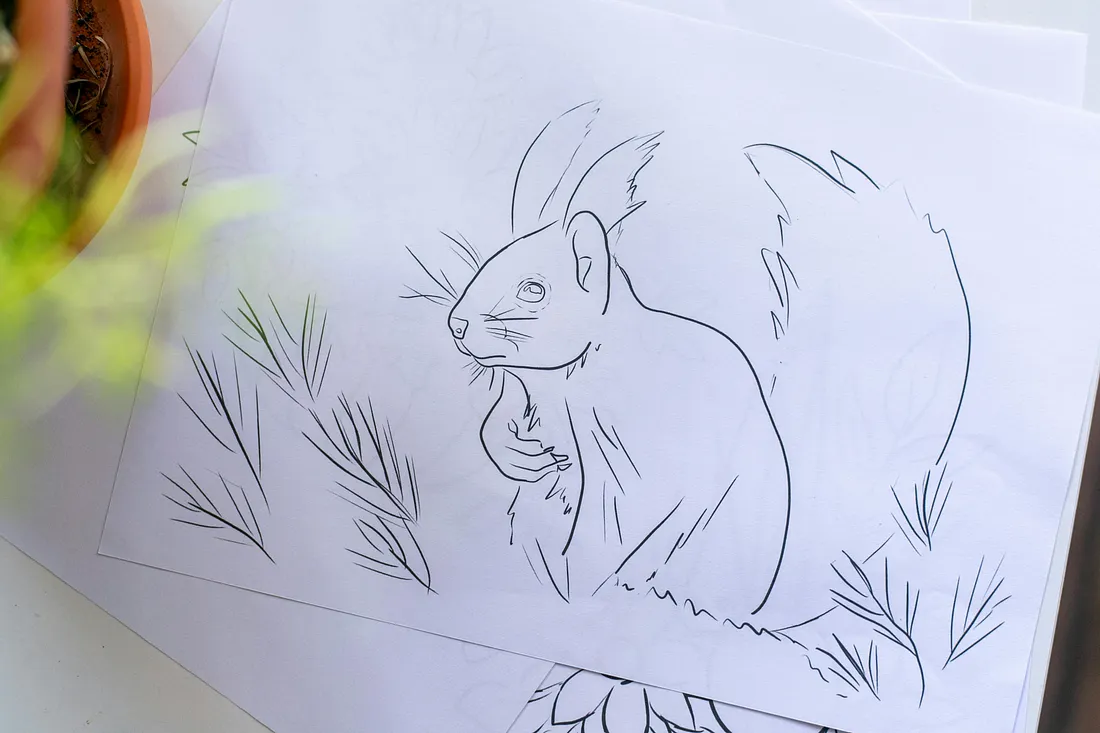
Mr. Nelson Mandela wrote a book which was titled, Conversations With Myself. I doubt that anyone who had seen that title, initially, had any concerns about his mental health. Perhaps no alarm bells went off because of the stature of the man and because the world was already aware of a great deal about his life to think otherwise. That being said, when I thought of the title of this opinion piece — “Parable of a conversation with a dead squirrel” — I wondered, despite the relative obscurity of my name and of my life, in comparison to those of Mr. Mandela, if my perceived sanity would be treated with the same positive expectations by my readers. And so, at great risk as to how I might be perceived by all who might happen to read this humble opinion piece of mine, I decided to proceed in writing it.
Squirrels have been part and parcel of the various environments in which I have found myself here in the United States. I do not recall seeing them as a schoolboy on my first outing abroad, off the shores of Jamaica, into Canada during a period of summer holidays away from school with my brother. Perhaps I had seen them after we ended the first leg of our vacation — flying across the border from Toronto into Washington, DC. where we spent a few weeks with relatives in Maryland.
Although squirrels are ubiquitous I do not recall having seen them on that trip. However, after returning to Washington, D.C. several years later to attend university there, they became, during that period of time, somewhere in the forefront of my mind, along with, to a lesser extent, raccoons. Where I now live in South Florida they have often been the subjects of many photographs which were taken while on many of my walk-abouts.
Unlike Dr. Doolittle, I have no claims about being able to talk to animals, and I never entertained any desires about talking to animals, with the exception of talking to the dogs and to the cats which my brother and I, as boys, had as pets in the vein of: “Come Rex!” or, “Sit down Spike!” or, “Behave yourself Tammy!” or, “If you don’t settle down you are not going to get your food!” Outside of that, there were no philosophical or dialectical conversations which I had tried to enter into with animals, including squirrels.
It was good enough to see them chasing each other up and down trees with their bushy tails – squeaking; to watch them foraging for food, and contentedly nibbling on nuts. But, not so long ago, I found myself engaged in conversation with a squirrel who was laying prostrate, under a tree, one sunny Sunday morning, near to the front door of my townhouse. The conversation between us was wordless, bordering on telepathy.
It was unusual to see him lying so still and on his back. I am sure, like all mammals, that squirrels do feel the need to sleep, but not in broad daylight, not on their backs, and not leaving themselves vulnerable to large predators. And then, in addition to his utter stillness, I soon realized, from the cologne that he was wearing, which was emanating from his furry body, that the essence of life had vacated his body several hours before. In fact, it was the cologne which he used which had alerted me to his presence.
I was on my cellphone at the time talking to a friend when he had rudely interrupted my conversation with it. I was in and out of the house the day before, so how come I was so oblivious to his presence then, that is, until, I had discovered him or he had discovered me? I did not know. But, no sooner had my telephone call ended my conversation with Mr. Squirrel promptly began.
Without hesitation I demanded that he get up and leave the immediate environs of my home. I conveyed my great displeasure at his presence and the discomfort and the health risks that he posed to my family and I, and also to that of my immediate neighbours. No answer. I went on to explain to him that where I live had very strict homeowners’ association rules which, though they respected his rights and those of other creatures in the wild under the laws of nature, they did not tolerate his current behaviour. The management company, which is contracted to oversee all matters concerning the property and to enforce the rules, prohibited what he was doing. No answer again. And so, after several minutes of trying to make my point and to engender within him even a modicum of respect for the rules and for the sensibilities of my family, it became increasingly clear that he was dead set on not complying with my request. I was annoyed, needless to say, as I did not want him there. I expected him to move.
I was right and Mr. Squirrel was wrong, and I was sure of that. I believe that he knew that too. The law was on my side. But he was dead set on continuing to lay where he was, under the tree, right next to my front door, with a macabre looking grin frozen upon his face. There and then he reminded me of politicians and of other public servants, all over the world, who seem to be able to win arguments despite the facts, despite the rules, despite the regulations, and despite all of the compelling arguments levelled against them by their critics.
Despite what everyone knows to be right and practical they have managed, somehow, to manipulate situations in order to gainsay and to circumvent the rights of others for their own aggrandizement. They are so dead set in their ways that they seem to be immune to everything in life that others hold dear. They are like dead squirrels.
The norms, rules and regulations which apply to those who are alive cannot be applied to those who are dead. Therefore, to entertain any expectations that those who are dead will, somehow, at some point, miraculously respond as the living do is sheer lunacy. With those thoughts in mind there are people in this world who have a long track record of being unwilling, unable, or both, to comply with and much more to promote what has been accepted, universally, as normal and lawful. As a result, for centuries, law-abiding citizens have put punitive measures in place in order to deal with incorrigible and recalcitrant individuals among them. And so, what can we say of any society today which begins to express any hopes that such individuals will ever change, and that they will, in the long run, and while still retaining attitudes of patent and uninhibited lawlessness, be of any benefit to the rest of society? Can that which is bitter produce what is sweet? Would not such a mindset of the majority border on sheer madness? Therefore, in light of what we are seeing in politics the world over, has humanity gone absolutely insane?
The dead squirrel reminded me, for example, of the attitude of some politicians in the Jamaican Government who have long been accused of corruption but who have managed to succeed with their malfeasance, despite existing laws against such conduct, despite all the concrete evidence gathered against them, and despite the compelling arguments used in tandem with such evidence which, under normal circumstances, would have seen regular people already arrested, tried, convicted and placed behind bars in a penitentiary. But, as they say, “the world is not level”.
And, again, we have politicians within the United States who have not only been accused of the most heinous crimes, but who have been actually tried and convicted before serving, nonetheless, in high-profile public positions. Although the courts are behind law-abiding people, in some respects, such politicians, somehow, have managed to use extra-legal and immoral machinations in order to gainsay and circumvent what is reasonable and right. It is as if there is a deadness of soul and of conscience within them which defy the force of reason that would topple others who conduct themselves in such fashion. And, the sad thing is, we the citizens have helped to put them in office and to keep them there in the hope that they will make our lives better.
But, can what is bitter produce what is sweet? I believe that we must now write rules for the dead of whom I speak and be prepared to enforce them in order to secure the well-being of the living. Legislatures have to go back to their drawing boards in order to effect much different outcomes.
Mr. Squirrel, without saying anything, had put me at a crossroads, like those created by our politicians, via their untoward behaviour. Was I going to be one who pretended that he was not there — looking the other way? And, if so, at what cost? My inaction was not going to change the situation, and the evidence suggested that with the passage of time things were really going to get much worse and incredibly uncomfortable for me and for my neighbour. Could I call someone else to deal with the matter? The answer was, most certainly, in the affirmative. But, there were no guarantees that the relevant authorities would have come to my aid, and, even if they did, that they would have responded in a timely and in an efficacious manner.
The problem was as much mine as were the choices before me concerning it. I did not cause the squirrel’s demise, but it was well within my power, despite the fact that he refused to leave, to find some way for his disposition, which I did. He received a burial at sea in a nearby lake, without the utterance of prayers.
For many liberal democratic electorates around the world, under political regimes which are rife with corruption and lawlessness, they might not have been the wombs from which such ill-gotten offspring were birthed, but they, at a minimum, served as midwives which enabled them to come into being.
Now, some within the populace, understandably, are powerless to speak truth to power and to bring leaders to heel, but what of those who can do something but who choose to do nothing? Could such people separate themselves from the stench of rotting outcomes which were caused by those in power, those dead set in their ways? We have to write new rules for such leaders, not expecting that they will play by the existing ones.
Liberal democracies, the world over, which are shrinking, require, I believe, an ideological paradigm shift in order to survive. Perhaps what we need is a new and a more effective system which will honour the concerns raised by the English philosopher, Thomas Hobbes, with respect to maintaining law and order in society, yet, at the same time, establishing laws which will safeguard society against the introduction and the normalization of corruption, violence and murder as accepted means of retaining power and of governing hapless and helpless people, as was espoused by the Italian philosopher, Niccolò Machiavelli. To continue to conduct ourselves as if everything is normal would be nothing less than sheer folly. We have a lot of dead squirrels to deal with, and deal with them we must.