From the first Africans were brought to Jamaica against their will, they have been fighting for freedom and independence. Freedom and independence from their captors and from the colonialists, Britain. The resistance has been constant, bloody and often led to deaths. Many heroes have arisen out of the past struggles and memorialized to this day, while many paid the ultimate price in the struggles for freedom, yet to this day, unknown in our history. Eventually slavery was abolished from the island on August 1, 1834, after a long history of resistance against this brutal period of inhumane subjugation.
As recorded by the African Caribbean Institute of Jamaica/Jamaica Memory Bank, the timeline to independence for Jamaica was as follows:
- 1929 – Jamaica’s first political party, the People’s Political Party was formed under the leadership of Marcus Garvey who had returned to the island in 1927.
- January-May 1938 – Labour riots occurred at the Frome factory owned by Tate and Lyle. The police killed four protestors and wounded nine. The unrest extended to the Kingston waterfront and a general strike was called, with one of the leading figures being Alexander Bustamante. This unrest led to the formation of the Moyne Commission.
- 18 September 1938– The People’s National Party was launched with Norman Washington Manley as the leader.
- 8 July 1943 – The Jamaica Labour Party was launched with Alexander Bustamante as leader.20 November 1944 – A new Constitution came into effect in Jamaica, which afforded voting rights to all Jamaicans over the age of 21.
- September 1947 – The first Conference on British West Indian Federation in Montego Bay with leading West Indian politicians and Arthur Creech-Jones, Labour Secretary of State for the British Colonies, present.
- 20 December 1949 – General Elections won by the Jamaica Labour Party with 17 of the 32 seats in the House of Representatives. The PNP gained only 13 seats despite getting the popular vote with 43.5% to 42.7% for the JLP.
- 12 January 1955 – General elections won by the People’s National Party with 18 members elected to the House of Representatives with 50.5% of the popular vote, to 39.03% for the JLP who won 14 seats.
- 2 August 1956 – Parliament of Westminster passed the British Caribbean Act to establish a federal union among the territories making up the British West Indies.
- 3 January 1958 – The Federation of the West Indies was officially established.
- 1958 – During the Caribbean-wide elections, JLP won 12 of the 17 seats allotted to Jamaica in the Federal West Indies Parliament.
- 28 July 1959 – PNP won the General Elections once more with 24 of the 45 seats of the house and 54.8% of the popular vote. The JLP won 21 seats with 44.3% of the popular vote.
- 3 November 1959 – D.C. Tavares from the Jamaica Labour Party proposed a referendum to decide if Jamaica should remain a part of the Federation in Parliament.
- 31 May 1960 – Alexander Bustamante released a public statement declaring that the JLP “would oppose the Federation and to do everything within their power to secure Jamaica’s withdrawal.” In response, Norman Manley agreed to a referendum so that the people could determine the nation’s fate.
- June 1961 – The first motion specifically seeking a date for Jamaica’s Independence was proposed by L.G. Newland, JLP member in Parliament, who moved to request “Her Majesty’s Government to take the necessary steps to introduce legislation to grant Jamaica Independence on the 23rd May 1962 and to seek admission for Jamaica in the British Commonwealth as a Dominion.” This motion was defeated by the PNP.
- 19 September 1961 – Jamaica voted on the Referendum to determine if the country should withdraw from the British West Indies Federation. The majority (54%) of the electorate voted in favour of withdrawal, supporting the JLP’s stance, while 46% agreed with Manley and the PNP that Jamaica should remain in the Federation.
- 31 October 1961 – The first joint meeting of the Independence Committees set up by the House of Representatives and the Legislative Council of Jamaica was held at Gordon House.
- 10 February 1962 – A joint delegation consisting of Norman Manley, Florizel Glasspole and Vernon Arnett (People’s National Party); and Alexander Bustamante, Donald Sangster and Robert Lightbourne (Jamaica Labour Party) travelled to England and signed the Independence Agreement at Lancaster House.
- 10 April 1962 – General elections were held with the JLP claiming victory with 26 seats with 50.04% of the vote to 19 seats and 48.59% of votes for the PNP. Thus, Alexander Bustamante became the first Prime Minister of independent Jamaica at age 78.
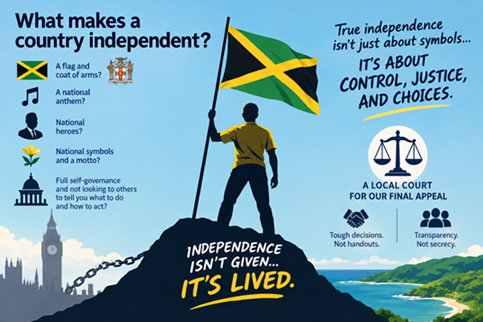
- 6 August 1962 – Jamaica became officially independent from Britain, and the occasion was commemorated with island-wide Independence Day celebrations and the raising of the new Jamaican flag.
So, it was a long, drawn-out process from emancipation to independence. In fact, it took all of 128 years! Many years ago, I was in conversation with a friend who said that he was convinced that the reason Jamaica seemed to be limping along for so many decades was because it got a weak start and has never really been able to catch up. The older I get, the more I agree with his serious academic analysis.
Sadly, Jamaica went into independence under the wrong leadership. Alexander Bustamante lacked vision. All he was hungry for was power. He was a charismatic union leader who was able to charm a largely ignorant voter population into believing that he was their guy. The new nation needed a serious visionary leader who was able to define the lasting culture of the society going forward in a positive way. We missed that boat in 1962 and have been playing catch-up ever since.
That in 2026, 64 years after declaring ourselves “independent” from Britain, it appears that we as a nation have simply replaced Britain with America as our new colonial masters, is a betrayal of our long history of resistance. We have betrayed our ancestors who fought, struggled, and died while suffering some of the most inhumane treatment in this society. The objective of the centuries-old struggles was to secure sovereignty where our people can live in a State where we make our own decisions on how we live, establish our own relationships while charting our own future as a nation, not to shift dependency from one colonial master to another.
Jamaica is potentially a rich little country with an enormous potential international reach. Unfortunately, we have been saddled with too much weak leadership for too many years since 1962. Our so-called democratic approach to governance has led to too many stops, restarts and waste in the use of our resources over the decades. This has led to an anaemic state of development over many decades.
Real sovereignty demands independence backed up by strategic approaches to governance. For example, there is absolutely no reason why Jamaica shouldn’t be self-sufficient in agriculture. Also, we’ve been training and preparing medical personnel and teachers for decades, many of whom leave the country to work in other countries for better compensation. Most of these people would prefer to stay in their country and contribute to its development. Why is it so complex an issue to resolve while we depend on imported talent from other countries?
I am always amazed by Cuba’s ability to develop such superior medical talents in their country, despite the challenges imposed on them by America over the decades. Why can’t Jamaica, without similar challenges, do the same? After 64 years of self-government, we are still importing far more than we export to other countries. And we call that development?
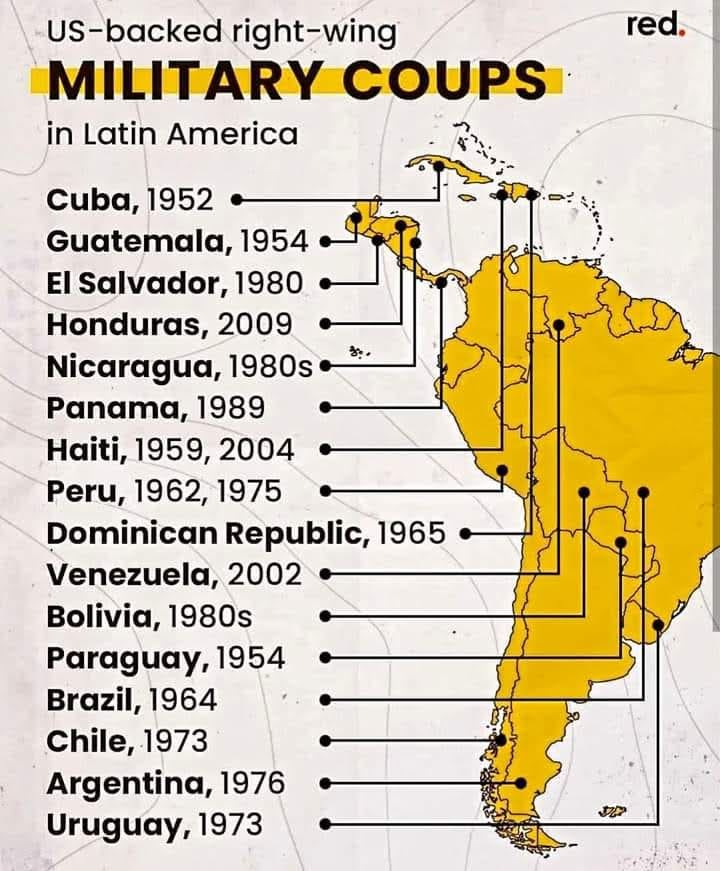
Sovereignty demands serious independence. Without that, we are left to the whims and fancies of bullying nations like America. I am always amazed at the resilience of the Cuban Government and people since the establishment of the illegal American embargo of 1952. For 250 years, America has been a bullying nation, threatening wars while dictating to other countries who they can and cannot have relationships with, as well as who should comprise their leadership. And it’s in order to control other nations resources! If that isn’t robbery, I don’t know what is. They have shown that they have absolutely no respect for the sovereignty and independence of any other country. Sadly, most countries fear their so-called military might. Something they have used over the decades to create more chaos and destruction over the world than to foster development.
I recall in the 1970s how they were relentless at undermining and destroying the nonaligned movement which so many countries outside the largely former colonialists established to forge their independent development paths. From engaging in regime changes to murdering leaders in the movement, they stopped at nothing to achieve their objective of world dominance and control. Individual nation sovereignty has never meant anything to these hustlers. We in Jamaica experienced their ugly interference in the 1970s, when they created chaos throughout our country and worked assiduously at facilitating regime change.
For so long, the world has needed a fair, just and equitable international order to replace the hypocritically named United Nations. History has proven that it’s probably not worth the extraordinary sacrifices and yes, loss of life if after so many centuries of struggle all we end up with is independence and sovereignty in name only while we merely shift from one brand of colonial rule to another.
In the final analysis, America’s regime change playbook has failed worldwide for centuries. Sovereignty is real and desirable. Countries did not fight for independence only to allow bullying, greedy nations to dictate to the rest of us