In 1838, slavery was abolished in the British West Indies. It was the end of an over 300-year policy, practice, and business of enslaving Africans to work on the sugar plantations on the various British Caribbean islands and Guyana. Slavery wasn’t abolished out of the goodness of the hearts of the British, who had a Damascene moment despite what they say about Pitt the Younger and William Knibb being leading lights of the movement. Slavery was abolished because the cost of maintaining the status quo was too high. The danger of Haiti was a real threat to the plantocracy, and the slave uprisings culminating in the Christmas Rebellion showed how easily the project could be irreparably lost.
It was the slaves who won their freedom through continuous struggle, rebellion, and revolt, and those in charge never forgot this or forgave the fact that people whom they viewed as hewers of wood and carriers of water were now freemen.
One of the lasting legacies of slavery and the unjust emancipation was landlessness. Following emancipation, all ex-slaves who did not wish to work on their former masters’ plantations were homeless. Those who stayed had to pay impossibly high rents and were eventually kicked off the land. A very select few ex-slaves were able to access plots in the new free villages formed by ex-slaves, oftentimes with church support. But again, this access wasn’t free, and while it was a mortgage that once paid meant you owned the land —oftentimes undesirable land — the rates were still too high and the land on offer too little that it barely registered on the scale when it came to addressing the issue of homelessness and landlessness.
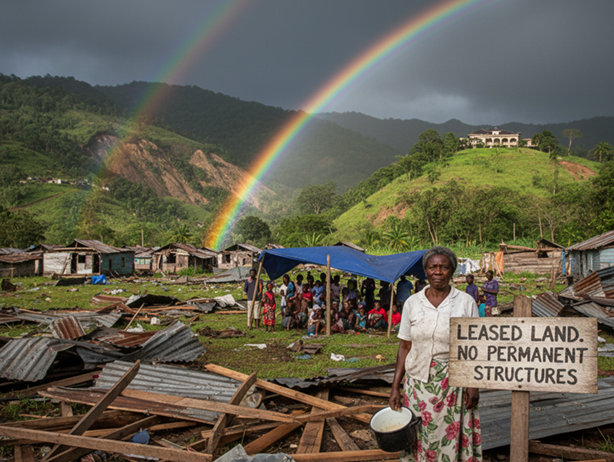
Some 200 years later, Hurricane Melissa has shown us that the issue of land, home ownership, and land reform remains the biggest issue haunting the Jamaican people. The hurricane has revealed what has been known but unspoken for years, that if you are black, and to an extent Indian, you are land poor, or occupy marginal land if you own it, or outright squat on Crown or private lands. The hurricane has revealed that it is black and Indian people in this country who, in the 21st century, live in chattel houses, not by choice, but because they can’t get anything better.
More than 150,000 houses were damaged, and over 20,000 were totally written off. If we go with the lowest estimate of 2 people per home, we are looking at more than 300,000 Jamaicans impacted, with some 40,000 with nothing to go back to but rubble.
How are we going to rehouse these people? Will the Government grants and National Housing Trust (NHT) loans be enough to rebuild? That much is doubtful, especially given the fact that these people will be looking to build more structurally sound — read expensive — houses. Do we expect these houses to be rebuilt or repaired before the next hurricane season? If the contracts are going to the developers who have done work in the past, we can safely expect them to miss that mark.
These are people who had homes, a place to lay their head at night and call their own, and now they have joined the great multitude of Jamaicans who have nought. This, though, is just the tip of the iceberg and underlies serious issues in this country relating to housing, which need to be addressed.
Why, for example, were people allowed to build in known dry river beds, next to gullies, dangerous hillsides, areas known to be sinkhole-prone, or next to beaches that have tendencies to have major storm surge issues? The sad truth is, we know why these things have been allowed to happen; it is because these people are the children of the unlanded, the ex-slaves and indentured servants who had nothing to their name after working and who were only able to access marginal lands not otherwise fit for use.
A lot of these houses simply should not be rebuilt in their current locations; many communities — both formal and informal —will need to be relocated as the country strengthens itself against future hurricanes. The question is, where will these people be relocated to, both as individuals and as communities? What land will they be moved to, who, if anyone, has the available land, and will they share it?
The answer to one of those questions is easy: the largest land holders are the Government of Jamaica (GOJ) — the Crown, the various churches, and then private individuals, people who polite society won’t allow me to name, but who come from a select few families, with some recent additions since the names were published in a book decades ago.
The easiest thing would be for the GOJ to do away with much of the Crown land and make it available for people to use. That would answer some questions but would not be the correct solution as it would leave the State in a weakened state when compared to private individuals who, even as things stand now, can overpower the State.
What is truly needed is land reform, the issue which has been ignored and kicked into the long grass for decades. We allow people to live on gully banks, squat in unsafe and unhygienic communities and then seek to regularise them; that is madness. The solution is wholesale land reform, which would invariably impact the State, but would wrench thousands of acres of land sitting in the hands of a few private individuals.
No one is talking about expropriation without compensation. As much as it pains me, we still live and operate in a capitalist world, and even the State must bow to the power of that. But what I am talking about is paying non-exorbitant prices for lands which they are not using, paying face value, as valued by the State — that is a perk and power of the State — for lands which are undeveloped, unused, or otherwise idle.
This is not some radical Cuban solution; this is actually the very lukewarm pro-capitalist agenda instituted by Jacobo Arbenz, and promoted by John F Kennedy. It is a solution which creates a budding middle class with access to capital through real estate, makes land productive, thus boosting the economy, and would even have the spinoff of seeing the unnamed families get a few dollars for land which they aren’t even using.
It is the obvious solution, which is probably why it hasn’t been implemented some 80 years after self-governance, and 60 years since independence. We are literally having the same discussion today which was had in 1838, 1865, 1938, and the 60s-70s. There has been and remains an unequal distribution of land, it is but one of the many open wounds we have from slavery, one which we are told to ignore but which gnaws away at our very fibre, even if we can’t put our finger on it. We feel it in our bones as a country, and it shows itself in the over 600,000 reported squatters who have taken matters into their own hands when it comes to the land question. The hurricane has caused more damage than we could have imagined, changed lives forever, and possibly even how we think as a country.
One takeaway from this should be that we can’t continue as we have done as it relates to land and access to it. Comprehensive land reform must take place as part of the relief and rebuild; whole new communities must be built, and it must come as a result of this land reform. Those impacted by the hurricane must get first dibs, of course, but it is something that must be extended to and benefit the broader population who have no land or marginal land.
This is something which has been put off for too long, ignored because it does not impact those in power and abused in order to win votes. It will be a difficult conversation to have, and the landed gentry will kick up a fuss if any hint of land reform is made, but it is a discussion we must have and a move we must make if we are to correct the historical wrongs inflicted upon us, and drive the country forward in a way which included everyone and not just an elite few.
We can’t keep kicking the can down the road; we will run out of road in the end, and at that point, history shows it ends badly. Let us do land reform now, while we can, before it is too late. Let us do it in a polite way before we are faced with the impolite demands from people who have justified grievances.